Part Six5G Pioneer Bands
PART 6 – 5G PIONEER BANDS
Quote: “Technology neutrality is a misplaced idea for national telecommunications infrastructures and associated radio spectrum bands” (Section B Rule The Ten Rules — Rule 66)
Context
Standards making, spectrum planning and national infrastructure ambition for GSM were closely linked. Around the turn of the millennium the link was broken. Spectrum management had come under the influence of free market economics. Governments and regulators became “technology neutral”. 4G was a huge standardisation success but the spectrum side was all a bit of an unruly mess. The result was a mad runaway world of ever more spectrum bands having to be packed into the tiny volume of a smart phone and its radio performance crashing. It was nobody’s job to plan ahead to match new cellular technology opportunities with new spectrum bands and improved national wireless infrastructures.
Chapter 31
MY ROLE IN THE 5G PIONEER BANDS THAT CHANGED THE DIRECTION OF 5G IN EUROPE
The very first international discussions on the desired goals for 5G brought forward many diverse ideas. One was a huge leap in data speeds to 10 Gb/s. The high data speed drove the need for very wide radio channels. This, in turn, directed everyone’s attention to bands above 6 GHz, where such wide radio channels might more readily be found. Samsung was one of the first companies to suggest 28 GHz on the basis that it looked possible to get global alignment. Everyone could see the advantage for consumers of a global allocation that would enable global scale economies for 5G smartphones and global roaming.
A data speed as high as 10 Gb/s was headline-grabbing. It played well in the popular media. The supply industry became excited by the opportunity to develop new components. In 2014, New York University hosted an influential technical workshop (the first of the ‘The Brooklyn 5G Summits’) that harnessed this excitement and helped forge an effective industry lobby for a global allocation for mobile services at 28 GHz and higher bands more generally.

During this first Brooklyn 5G Summit, the adverse impact on mobile coverage from using such high-frequency bands was hardly mentioned. It did not fit the narrative of the emerging industry consensus. The important market requirement for mobile wide-area coverage was getting buried under the excitement for a data speed of 10 Gb/s.
In the run-up to the ITU World Radio Conference in 2015 (WRC15), the bandwagon behind a global allocation at 28 GHz had gathered enormous momentum across the world and was backed by a number of governments, including the USA.
It is no exaggeration to say that by 2015, 5G had become exclusively synonymous with the use of 28 GHz to deliver 10 Gb/s to super-hot spots.
It left a number of mobile experts (me included) sceptical about the direction 5G was taking. Nobody in the mobile industry was against 10 GB/s hot spots using 28 GHz, but that alone was not going to be transformational. And what about the limited range possible at 28 GHz? People wanted mobile connectivity everywhere and not just at hot spots. But by 2015, these views had been marginalised. 5G had become inextricably linked by a strong industry lobby to the use of 28 GHz.
This was the backdrop to the much-anticipated ITU World Radio Conference held in Geneva in 2015 (known as WRC15). However, the mobile industry was not the only industry sector with its eyes on the 28 GHz band. In Europe, the satellite industry also had ambitions for that band. It was very important for their future development. At the conference, the European regulators took the side of the satellite industry. The European mobile industry lost this crucial battle. They left the conference with no obvious spectrum band in which to roll out the new 5G technology being standardised.
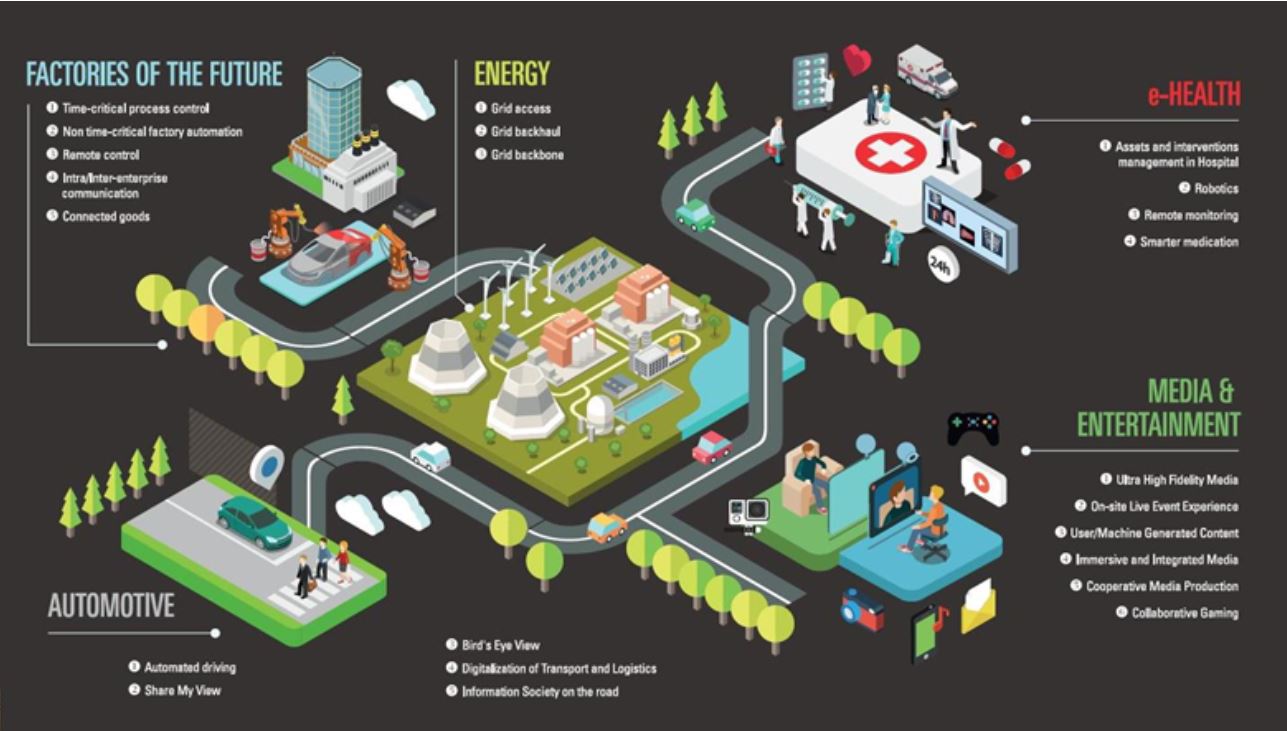
The EU Commission had invested a lot of capital in Europe being a leader in 5G. Even before the WRC15, the Commission had been doubtful about the 28 GHz 5G story. The disappointing outcome of WRC15 led EU officials to downplay new 5G networks. They switched attention towards new ‘applications’ they badged as ‘5G’, particularly the use of more advanced communications by the vertical industries such as transport, health, etc. In support of this, they tabled a draft measure for the EU to harmonise the use of 700 MHz, since most of these new applications needed national coverage whilst only demanding modest data rates. 700 MHz was an ideal band to cover wide areas at low cost, but no new technology was being developed for this band.
At this point, Europe had lost the plot. The advanced 5G technology being developed and standardised had no suitable band in which to roll it out, and the spectrum band at 700 MHz to be made available across the EU had no new technology being developed for it.
The large system vendors, such as Nokia and Ericsson, were angry at the WRC15 outcome and furiously lobbied the Commission to do something about it. The Commission could see no ready solution. They tasked the Radio Spectrum Policy Group (an advisory group comprising national regulators) to study the problem and report back by 2019. But there was even less enthusiasm amongst Europe’s national regulators to do anything. They were all technologically neutral. The issue had been effectively kicked into the long grass. The 5G initiative had derailed in Europe and covered over by a fig leaf of ‘5G services’ that for the most part would be running over 4G networks and wi-fi.
Whilst many in the industry realised the 5G initiative in Europe had been derailed by WRC15, few people fully grasped that no effective mechanism existed to solve the problem in the necessary timescale. Many still believed that the next ITU World Radio Conference in 2019 (known as WRC 19) would be an opportunity for a re-match of the fight over 28 GHz. It sustained hostilities between the European mobile and satellite industries in the 5G PPP infrastructure group and its Working Group on Spectrum. The result was that its Working Group on Spectrum (usually referred to as WG-Spectrum) had become dysfunctional and unable to articulate a common industry view. It was a car wreck.
In December 2015, Professor Rahim Tafazolli, Head of the University of Surrey 5G Innovation Centre, was in Brussels for a progress meeting of an EU-funded Horizon 2020 project called Euro-5G. The intended purpose of Euro-5G was to help coordinate 5G research activities and provide a gap analysis in support of EU officials. One of Euro-5G’s potential roles was to contribute to WG-Spectrum. Europe had reached an impasse on the 5G spectrum issue, and Rahim decided something needed to be done.
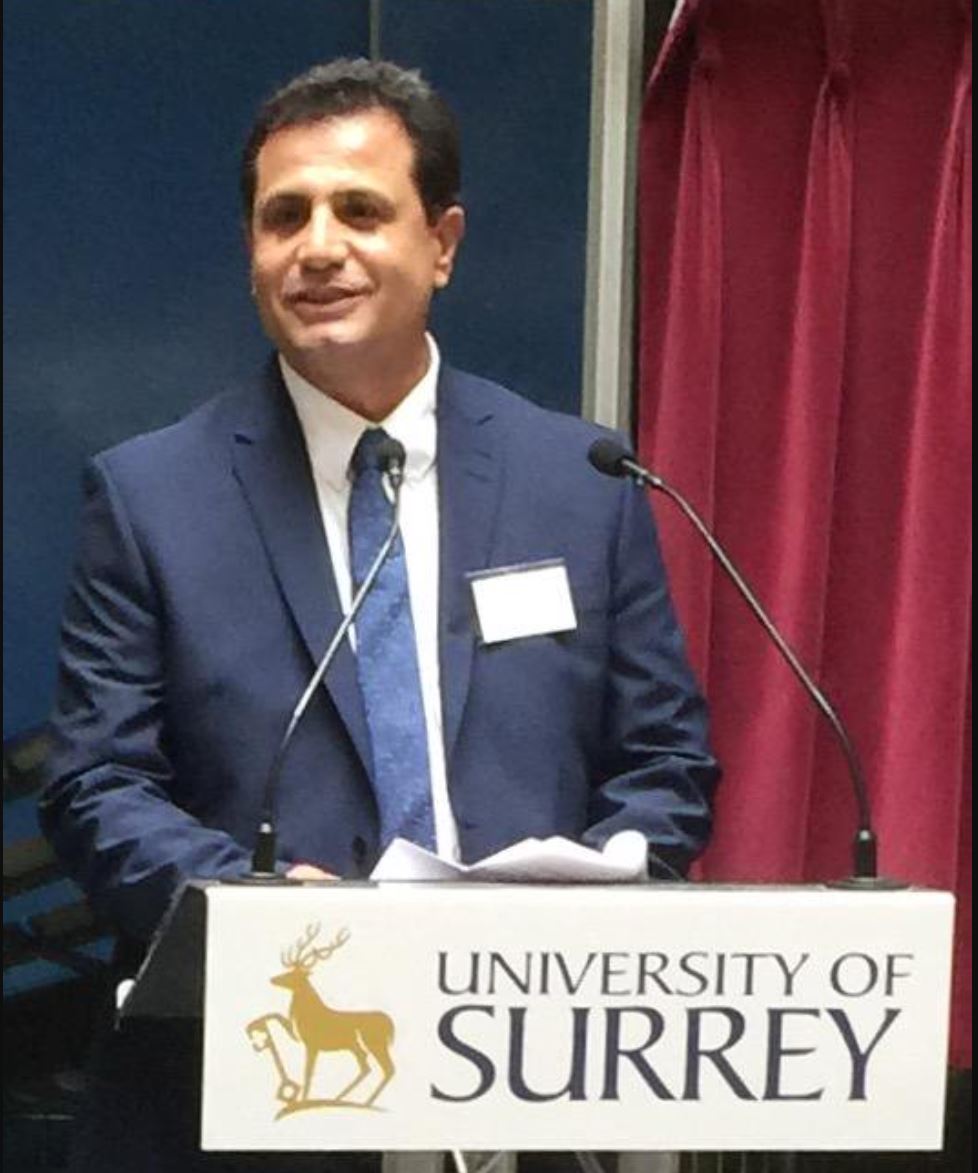
The other partner in Euro-5G was Terje Tjelta, representing Telenor. Unknown to me, Rahim proposed to him that I should represent the University of Surrey on Euro-5G in order to find a solution to this 5G spectrum logjam and assured him that if anyone could find a solution, it was me, based on my GSM success. Terje had in mind to put himself forward to chair WG-Spectrum. He had infinite patience and was going to need every bit of it. I had the institutional memory and know-how of why GSM had been so successful. It was a good combination.
The first I heard of this plan was after Rahim got back from Brussels. I was of two minds. First, it looked an impossible task. On the other hand, it was an area I knew a lot about. I agreed to take it on.
The first challenge was to get WG-Spectrum to actually meet. A face-to-face meeting was a vital first step in re-establishing trust after the trench warfare between the mobile and satellite industries in WRC15. The atmosphere was so bad it took nearly two months to get this first meeting set up in Brussels. The support of the EU Commission official, Ari Sorsaniemi, who represented the Commission on WG-Spectrum, was indispensable. In fact, without his encouragement and sensible interventions at critical moments, the initiative might have been crushed by the very aggressive lobbying efforts of the satellite interests.
Terje and I faced the creative challenge of making a success of the upcoming meeting of WG-Spectrum. It was going to be a one-shot opportunity. It was not immediately obvious where to start.
As luck would have it, in March 2016, Philip Marnick (Ofcom), the new chairman of the Radio Spectrum Policy Group (RSPG), called an industry workshop to set out their proposed work programme under his chairmanship. It wasn’t specifically about 5G spectrum. That was just one of the items on a list of things to be studied. It was fairly low-keyed. A senior national regulator (not from the UK) made a surprising comment, when presenting this work item, that nobody knew what 5G was. That did not bode well in finding a rapid solution, so I caught up with him in a coffee break. He told me that the prevailing view of regulators was that 5G had been over-hyped and might never happen. They had to study the issue so as not to upset the EU Commission, but they did not see it as their job to find spectrum for a specific technology and particularly one that seemed so problematic.
After the coffee break, Philip Marnick made a statement that gave me the first glimmer of light regarding a way through. He said the RSPG was not interested in industry’s lobbying the RSPG for a specific band (by which he meant 28 GHz) but instead they should present to the RSPG what the problem was that industry was trying to solve; the RSPG would then try to see if appropriate spectrum could be found. The plan was to deliver a final report by 2019. The timescale was not unreasonable measured in ‘spectrum management time’ but very late in the global race to launch.

The RSPG workshop was very helpful in posing the right question. What exactly was the problem 5G was setting out to solve? So far, the only question being asked was how the industry could get access to 28 GHz. Philip was re-setting the question. I liked the idea of framing the industry response around the problem to be solved. This made it more likely to find the right band rather than just the most politically expedient, as had happened with 3G.
The first task was to write a paper to shine a light on how spectrum management worked. It was really complicated. Nothing linked the progress of a new generation of technology with the release of a new spectrum band. The two worlds had become uncoupled. National regulators had embraced a principle of technology neutrality. Their position was that it was for industry to find spectrum for 5G from what they already had. But none had spectrum that could support the wide radio channels that are essential for 5G. It left Europe in a position where nobody had the formal duty to find spectrum for 5G. The conclusion the paper drew was that if industry did not offer-up a solution, the chances were that nobody else would.
Next was the really big challenge – an effective mechanism to get the regulators to re-engage in finding spectrum for a new technology in a way that did not involve their doing it by regulatory means. It had to be a ‘voluntary approach’ that secured market power through consensus and momentum. My solution was to come up with a new concept of the ‘5G Pioneer Band’.
My idea was to focus on the very first 5G deployment in the very first band in the very first country in Europe, then work out from there which ‘first band’ created the largest market size. Not requiring every EU country to have to agree made the problem soluble. All that mattered was the cumulative size of market by 2020 being big enough to attract viable commercial interest. My idea then was that this band would be used in our research and test beds, as it would create 5G equipment facts on the ground and therefore make it the easiest band to use. Once such a bandwagon could be got going, then other countries would come under pressure to join so as not to be left out. This intimate coupling of a band used for research and the same band used for the first deployment is why the words ‘pioneer band’ were chosen. Its greatest power is that nobody could find any reason to object to it. That mattered in the highly charged industrial politics of radio spectrum. The word ‘pioneer’ implied no compulsion, no regulation, and no exclusivity.
I noted its other various advantages:
- It permitted the research community to talk about the sensitive subject of what the first commercial 5G band might be since, by definition, it would be the same band we used for our research.
- The pioneer band approach created a counter-balance to the hitherto runaway mobile world of band proliferation. Some 44 bands emerged in the 4G standards period, causing massive design challenges that were proving impossible to resolve. Only a fraction of these bands appeared in popular smartphones. Coming up with another dozen 5G bands seemed an unhelpful approach.
- It improved the efficiency of the 5G research by eliminating the need for a re-banding development phase. The results of test beds and trials would be directly applicable to the planning of commercial services as the spectrum band would be identical.
WG-Spectrum were ready to give the approach a try.
The final challenge was to get industry agreement on the problem we were trying to solve. I prepared a third paper to demonstrate that one single spectrum band could not do the job. It was impossible to find one band that could deliver huge capacity (high data speeds) and pervasive national coverage at the same time. Going all out to find a band that maximised one would automatically lead to the other’s being minimised. The consequence for mobile coverage of using bands as high as 28 GHz was first brought to my attention in a presentation by Andy Sutton of EE at a University of Surrey 5G IC Technical Workshop.
This was an excellent example of the 5G IC industry/academia cooperation that helped direct academic thinking towards the real problems industry faced. The trick was to find a way of showing that at least three bands were needed and the necessary relationship with each other that could be understood at a glance. With a bit of artistic licence, I came up with the illustration shown in figure 80.
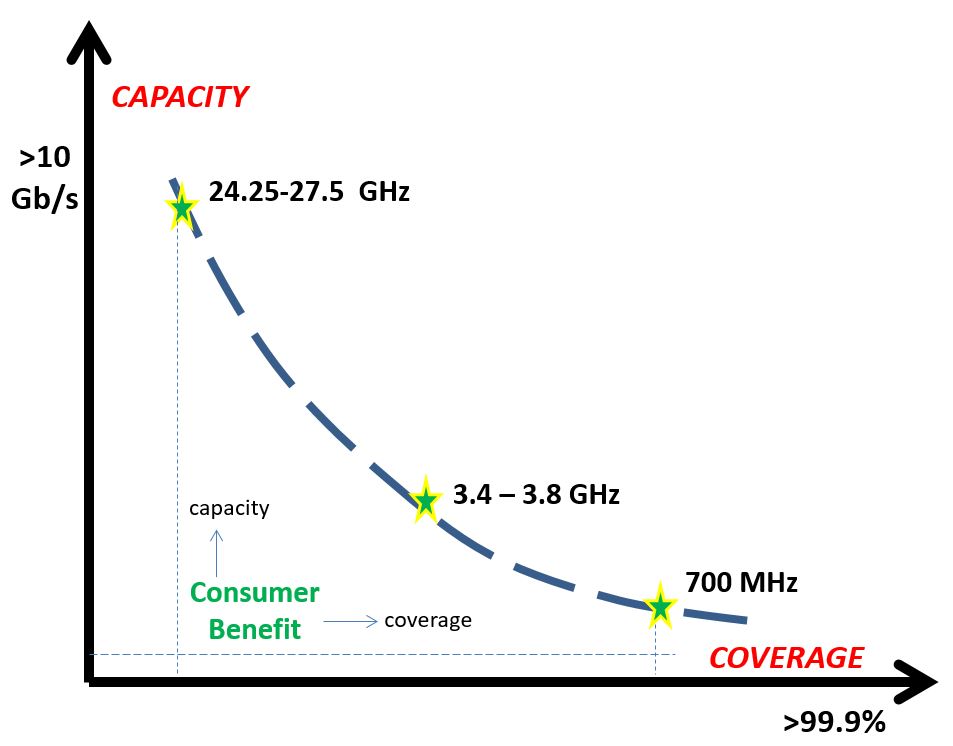
It coalesced views very quickly. Just three well-chosen bands would offer the very best combination of capacity and coverage for the least number of bands. The solution seems so obvious today, but in 2016, the University of Surrey was the only entity to have worked out that 5G needed to be powered by more than a single band like 28 GHz. It was Europe’s eureka moment. A few years later, I noted with some satisfaction a White House report on 5G in the USA that had borrowed my illustration, confirming the influence the illustration has had on the direction of 5G.
The 5G pioneer band initiative changed very quickly from an almost solo effort on my part to a team effort. Everyone was on board. We now had to prepare an agreed paper to go to Europe’s regulators. Rauno Ruismaki from Nokia stepped in to draft the section on the 26 GHz that quickly turned into 26 versus 32 GHz. His technical expertise was considerably greater than mine. I focussed on drafting the section on 3.6 GHz. It was the 5G band that Rahim favoured for dense small cell networks. It also had industrial support. Dr Wen Tong had mentioned to me at a Huawei event in Munich in 2014 that he thought 5G implementation might be faster at 3.6 GHz than 28 GHz. Nokia also supported it. A very far reaching statement I included, after discussion with Rauno, was that radio channel widths had to be at least 100 MHz wide. That was later to resonate across the industry. Everyone in WG-Spectrum was keen to bring 700 MHz into the 5G spectrum storyline. This was essential for a comprehensive approach to upgrading Europe’s future mobile broadband infrastructure. The chairman, Terje Tjelta, and our rapporteur, Ulrich Rehfuess, provided the leadership. (The rapporteur was the person we chose to represent us at meetings with the RSPG).
The 26 GHz versus 32 GHz choice proved controversial. On the one hand, the satellite interests and SIP from Italy wanted 32 GHz, and everyone else wanted 26 GHz. An impasse in WG-Spectrum quickly emerged that could not be resolved. It was more efficient just to let the RSPG finally settle the matter. Ulrich Rehfuess took on the unenviable task of finding a text that balanced on a knife edge the pros and cons of the two options.
I knew Europe’s regulators were seeing 5G through an entirely different prism. I therefore copied every draft version to David Hendon from Ofcom, who helped me shape the 5G PPP papers into a form that he and his Ofcom colleagues could best use to build the wider consensus. David also happened to be the Chairman of the University of Surrey 5G IC Strategy Advisory Board, and I was the Technical Secretary. The resulting ‘working level’ close cooperation in solving the 5G spectrum blockage problem proved the value of the 5G IC in pulling around the same table the entire UK mobile eco-system.

The hard slog of satisfying everyone’s drafting points was finally over (and at times it was really hard) and the papers had been pre-cleared with the Ofcom RSPG delegates. I was five minutes away from pressing the ‘send key’ to dispatch it to the RSPG 5G Working Group when I received a shock e-mail from a senior Commission official. I was not to send it. It went against EU policy. His concern was that EU policy was to focus on 5G applications and something aimed at advancing 5G networks would be sending out mixed messages.
I stared at the e-mail in disbelief. Fortunately, I had been in this situation once before when I was a senior civil servant. Lord Young had arrived in the DTI a few days before I was to fly out to Copenhagen to get the now-famous GSM Memorandum of Understanding signed. He had forbidden me to go just a few hours before I was to leave for the airport. The only way was to stay cool, present a very balanced argument and allow the person to work out for himself what was for the best. Within two e-mail exchanges, the paper was on its way with the senior Commission official’s blessing.
The 5G pioneer band seed had germinated in the 5G PPP incubator, and it would now fall to others to nurture it to fruition. Industry had come up with the problems to be solved and a near-ideal solution.
From that point on, the action moved to the RSPG. Philip Marnick, its chairman, set a cracking pace to get RSPG consensus behind the 5G pioneer bands. He was under pressure from the EU Commission on timescales. They wanted the RSPG input in time to publish the EU’s 5G Action Plan by September 2016. A working group under the chairmanship of Bo Andersson, Chief Economist at the Swedish National Post & Telecom Authority, was established. Philip Marnick made it known that he wanted a draft Opinion from the group for RSPG to adopt in a matter of weeks rather than months, so the work of the Group focused on what could be said before the end of 2016.
The 700 MHz band was already a done deal as a result of the Commission’s initiative. The real work was to get agreement on the 3.6 GHz band and sort out the 26 versus 32 GHz issue.
David Hendon and Joe Butler from Ofcom, working closely with Eric Fournier from the French regulator ANFR, first got the Group to focus on the 3.6 GHz band. Different countries had different levels of availability of parts of the band, but nevertheless, the imperative of having several 100 MHz carriers available in each country led to the whole of the 3.4-3.8 band being identified as one of the 5G pioneer bands. There was even a suggestion added that it was where Europe could secure a global lead in 5G. That was a very powerful signal, with 400 MHz of bandwidth to back it up.

Philip Marnick led a process in Ofcom to decide whether the UK would prefer 26 GHz or 32 GHz as the third 5G pioneer band.
26 GHz was heavily used for fixed links in many countries. 32 GHz, on the other hand, was less heavily used. However, a powerful argument was being mounted that 26 GHz was better for the global harmonisation of smartphones. It was possible to envisage that devices could be made that could be tuned across both the 26 GHz and 28 GHz band. This could lead to one common global smartphone. But the same wasn’t true for 32 GHz, where a 1 GHz ‘quiet band’ sat between the 28 GHz and 32 GHz bands. Building filters to protect this band in practical devices would be very expensive and cumbersome. Furthermore, from a survey of the opinions of some key regulators across the world, Ofcom reached the view that it was more likely that 26 GHz would emerge as a global band. It was a thoughtful debate. 26 GHz emerged as the right solution.
Joe Butler took this conclusion to a meeting of the RSPG 5G group in Dublin in late July 2016 skilfully got 26 GHz into play. The issue was discussed again at the next meeting of the RSPG 5G group in London after the summer break. A fragile consensus emerged for 26 GHz, but there remained some who were unhappy or whose delegates had not been mandated to support this conclusion. However, by the end of the meeting, there was a text that could go to the Plenary. Further behind-the-scenes consensus-building took place. The Plenary was able to agree on the choice of 26 GHz with some safeguard wording added. The final RSPG Opinion was ready.
The Commission were delighted with the outcome. They smoothly picked up the 5G pioneer band choices when their 5G Action Plan was published on 14th September under the heading ‘Unlocking bottlenecks: making 5G radio spectrum available.
The RSPG Opinion on the 5G pioneer bands was published in final form after the EU 5G Action Plan on 9th November 2016.
The three 5G pioneer bands were cemented into Europe’s 5G approach:
Low band 700 MHz,
Middle band 3.4 – 3.8 GHz (3.6 GHz band), and
High band 24.25 – 27.5 GHz (26 GHz band).
- Low Band – The ubiquity of the Internet of Things is to be underpinned by a network engineered at 700 MHz to offer very reliable, near-universal connectivity and cope with billions of devices. It is also likely to emerge as a universal control plane.
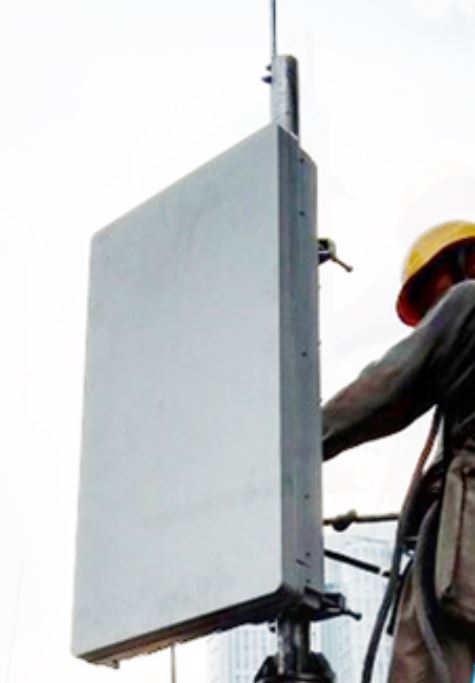
- Middle Band – Massive MiMo shaping narrow, high-gain beams would allow economic coverage of urban areas at 3.6 GHz, with dense small cell networks in areas of exceptionally high traffic and in-filling of gaps missed by Massive MiMo systems. It was also a better choice indoors than WiFi at 60 GHz.
- High band – On top of this would be strategically placed super-hot spots at 26 GHz to meet huge peak demands at football matches, other locations of very high footfall and within factories of the future. The problems of finding a global spectrum band for this has been neatly resolved by having two bands, 26 GHz and 28 GHz close enough together so that only a single tuneable component is needed for both.
Other parts of the world limited their opportunities by asking themselves the wrong question: the 5G band is 28 GHz; now what can I do with it? The answer is: not a lot.
Whilst the pioneer band initiative went exceedingly well, it proved far tougher to get across to regulators the message that 5G needed wide radio channels (of at least 100 MHz) to deliver its exceptional high performance. It clashed with orthodox regulatory thinking of fragmenting bands into smaller bandwidths for competition reasons. In 2016 I had a heated telephone call with David Hendon from Ofcom on the issue. He stoutly defended the regulatory status quo as immutable and I tried to find a way of reconciling this with the much-needed wide radio channels emerging to make a success of the 5G technology. The only solution we could find that could satisfy both was for Ofcom to ‘over-license’ rights that would allow mobile operators to expand their radio channels opportunistically to the full 400 MHz band in locations where other operators were not present. I lobbied tirelessly for this idea but to no avail. Until, in early 2018, I was asked by Lord Willets to prepare for him a keynote address to give to the global dynamic spectrum access conference in London. He liked the idea of a technology that could make use of the spectrum being wasted across large areas of the country with Ofcom’s orthodox approach. It caught the moment. The Government’s Future Telecommunications Infrastructure Report, published in July 2018, introduced the idea into the national debate. The potential upside for millions of people living in rural areas is substantial.
Retrospective – How well did it turn out?
The University of Surrey 5G IC was the only entity in the world to understand the implications of the concurrent demands for capacity and coverage and to conclude that the benefits being claimed for 5G could not be delivered by a single frequency band, whether at 28 GHz or any other band.
The ‘5G pioneer band’ initiative achieved four specific things:
- It broke the 5G spectrum logjam in a way that allowed a technology informed choice of near perfect bands for the different future national infrastructure requirement being addressed.
- It brought ‘coverage’ back centre stage along with capacity in driving the choice of spectrum bands.
- It reversed the mad dash towards mobile band proliferation. The focus on the minimum number of bands essential to solve the problems will lead to more efficient smartphones and networks.
- It improved the efficiency of European 5G wireless research projects and kept Europe in the race for 5G leadership.
.