Chapter 30
TURNING THE ETSI VISION INTO A CREDIBLE REALITY
Managing the Technical Assembly
The first meeting of the ETSI Technical Assembly took place at the Acropolis Convention Centre in Nice from 31st May to 1st June 1988. The UK delegation took its seats at the very top of the auditorium. The stage was a long way below. A pair of opera glasses would have been helpful to see the people on the stage. My nomination as chairman was proposed by the Portuguese administration and followed by a round of applause. I was elected. Lars Ackzell from the Swedish administration and Jean Masure from Alcatel were then elected as my two vice chairmen. I made the long walk down the flight of steps and up onto the podium and sat down. I glanced up. There were about 200 people from the most powerful telecoms organisations in Europe seated in banks and banks of terraced seats in a semi-circle. In that fleeting few seconds of silence, my mind was racing ahead on how I was going to get 200 people all to come to agreement on a packed agenda that allowed roughly 40 minutes per agenda item. The silence could not go on forever, and I was just going to have to learn on the job.
The traditional opening speech for this sort of appointment would have been a long flowery vision. Instead, I cut to the chase and set out the three priorities for ETSI:
- To transfer all the technical standards work going on in CEPT to ETSI without any loss of momentum;
- To listen to what the EC Commission wanted of ETSI for the completion of the Internal Market by 1992, and to respond dynamically;
- To add an extra ingredient to European standardisation so that telecoms standards making kept up with the market needs and fast-moving technology.
From then on, it was a steep learning curve. Success (survival) involved understanding the viable options, listening intently to every intervention, working out their value, tracking the build-up of sentiment and formulating in my mind a summary that was likely to command the support of the majority. For controversial matters, the skill was knowing when to take a coffee break for a bit of serious diplomacy.
Each Technical Assembly would be preceded by a meeting with the Director. He set out for me the decisions he needed. Between Technical Assemblies, I had a meeting with all the Technical Group chairmen. This identified all the decisions they needed. Finally, the GA Chairman, Vice Chairman (Hans Weiss), the Director and I constituted an Executive Group. From this would come policy decisions the Technical Assembly needed to take. The pace was fast, and the Technical Assemblies intense, but it worked. The reason for this was that the Executive Team and Technical Assembly team (including Technical Committee chairmen) were exceptionally cohesive.
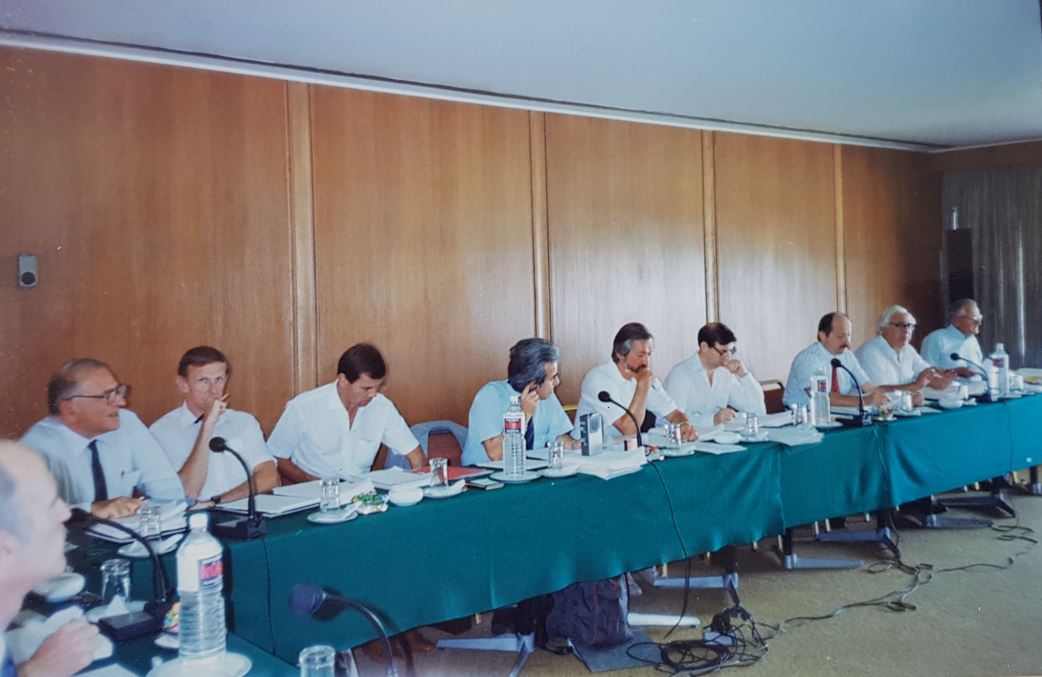
Visitors were often surprised that I seem to know the names of all the 150-200 people in the room. However, very early on I discovered it was the same 15 people that made 90% of the interventions. Once I’d twigged this, I would make a lightning tour of ‘the usual suspects’ during the coffee breaks to understand where I had to land something to get rapid agreement. They were all there to find solutions and contributed positively to building-up the momentum of ETSI standards making. Some of the great names of the period were Mr J-P Duplan (France Telecom), Mr A Vighi (Italian Administration), Mr G Robins (Alcatel), Mr Grohmann (OPT), Mr P Hammelberg (Netherlands PTT), Mr J Long (Racal Milgo), Mr A Gnetti (STET), Mr B Viklund (ITS-Sweden), Mr Van Egmond (Philips), Mr Gabler (DBP), Mr F da Silva (Portugese Administration) and Mr D Hendon (DTI).
The EU representative over the period was Mr J Richter.
There was one irritating delegate who always intervened on a trivial detail, just when I thought I’d secured a decision. When I saw his hand go up my heart would sink as some precarious agreement hung in the balance. But I learnt to listen to him carefully, as he often picked-up on flaws everyone else had missed.
The ETSI Technical Assembly minutes over the period 1988-92 are a catalogue of decisions taken, directions established and priorities set…all argued-out in a very open forum for the rest of the world to see.
ETSI Technical Committees
The ETSI Technical Committees were the standards making engine of ETSI. A decision was taken in the CEPT preparatory group that the existing CEPT working groups would be brought over as going concerns, with their existing chairmen in place. The alternative was to have started from scratch. That could have left ETSI producing no outputs for several years. ETSI’s backers would quickly have lost faith if nothing was coming out of the door. The first Technical Assembly approved my plan for the transfer of the relevant CEPT working groups:
Terminal Equipment – September 1988
Signalling, Protocols and Switching – December 1988
Transmission and Multiplexing – December 1988
Network Architecture – December 1988
GSM – March 1989
This effectively meant that ETSI began its life as a standards-making body in September 1988. I deliberately left GSM last as I saw the GSM standard as potentially “the crown jewels” of ETSI standards. GSM was well led, self-managing and under huge operational pressures to deliver the standard against an almost impossible deadline. I was determined that they would be protected from the disruptive forces of the ETSI revolution. When GSM eventually arrived in ETSI there was immediate friction between the ETSI secretariat in Sophia Antipolis and the GSM team based in Paris. I had to arbitrate. The ETSI secretariat were instructed that getting the GSM standard out of the door in time was to take priority and alignment of processes would come later.
The next threat to GSM came from the premature standardisation of the Universal Mobile Telecommunications System (UMTS). The early standardisation efforts for UMTS were being handled in a parallel ETSI technical committee on Radio Equipment and Systems (RES). The industries behind the UMTS were stepping-up the pace with a view to a rival standard to GSM emerging on a comparable time-scale. I took the decision to remove the UMTS activity from RES and into a sub-group of GSM. My objective was to slow its pace so that UMTS could be sequenced as a subsequent generation of mobile technology. It was a controversial move. However, it set the pattern of orderly generations of cellular mobile technology standards that has been sustained all the way to the 5th generation (5G)
By March 1991 the number of technical committees had grown to ten and it was the first time ETSI effectively had in place a process for appointing its own chairmen. The curtain was finally drawn on ETSI’s CEPT inheritance of chairmen. The transition was over. Mr Borgeat (France Telecom), Mr Moore (British Telecom) and Mr Haug (Televerket) were the only people from the CEPT old guard to sustain their positions on merit in the new ETSI ‘equal opportunities’ environment. It had been an incredibly smooth transition and ETSI was able to proudly deliver its GSM standard on-time. GSM went on to become a global runaway success.
ETSI’s Relationships with other Bodies
Ib and I took the lead in establishing ETSI’s relationship with other bodies. Ivor Knight, the Chairman of the US TI committee, was alarmed at the prospect of regional blocks fragmenting global standards. He took an initiative to invite ETSI and the Japanese TTC to a conference in Fredericksburg. Out of this came a commitment to invite representatives as guests to attend the two ETSI Assemblies.
I made a point of having a working lunch with our guests from other parts of the world during a Technical Assembly. This laid the foundation of trust that was helpful to the second Director, Karl Heinz Rosenbrock, when he later developed the 3G PP standards making partnership to take over from the outstandingly successful GSM.
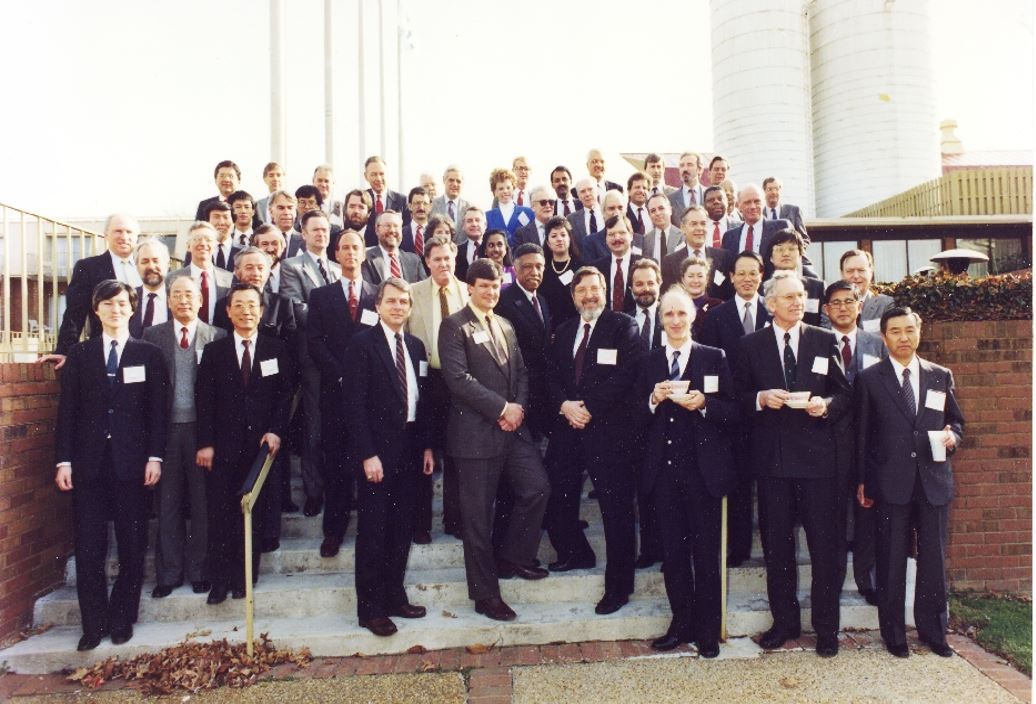
I had good relationships with the broadcasting community from my earlier days in broadcasting satellites and quickly brought the EBU into the ETSI orbit as a partner. This allowed DVB later to be linked to ETSI to ensure convergence rather than competition between telecoms and broadcasting technology standards. The DVB constitution was personally written by Armin Silberhorn and me and we were able to carry-in all the lessons learnt from the creation of ETSI.
I gave a lot of thought to our relations with the EU Commission. It seemed demeaning to bring them into our Assemblies as mere observers. On the other hand, we did not want them getting the idea that they could govern what we did. I invented the term ‘Special Counsellors’ to capture the right balance. It rather suited the personality of the EU Official, Mr Richter, who normally attended. The Commission exercised their influence through funding the work they wanted done.
Relations with the European Committee for Standardisation (CEN) and the European Committee for Electrotechnical Standardisation (CENELEC) were frosty. They were furious that the telecoms sector was to have its own recognised standards body. It challenged them in two ways. First, they feared it might be the thin edge of the wedge, where other sectors might want to break away to form their own sector standards body. Second, the direct representation of industry on our technical committees contrasted with their approach where national standards bodies were the gatekeepers.
At first, they simply refused to talk to us. Then, under pressure from the Commission, they agreed to a meeting, but the Chairman of CENELEC in particular kept cancelling the meeting at the last minute. It was deliberate. In a moment of irritation, when this happened for a third time, I wrote a furious letter accusing them of being relics of the past. I added that, like our English King Canute, who tried to order the tide not to come in, they were going to get very wet indeed if they didn’t also modernise. We were the future. I wrote the letter just to let off steam. I set the letter to one side to re-rewrite in more diplomatic terms when I came back from my next trip. While I was away, to my horror, my secretary Mandy came across the letter, put it in an envelope and sent it. Over the next week, the photocopying machines went into overdrive across Europe. The first time I knew the letter had gone out was an angry note from the Danish minister telling me that King Canute was a Danish King!
Eventually we met, and relations were put on a business-like footing. The olive branch I offered was for ETSI to use the national standards bodies for the formal public inquiry all standards go through before they are finally ratified as public standards.
In July 1990, EU Commissioner Bangermann (the Commissioner for Industry) convened a summit of the executives of three recognised standards making bodies. It was to be held in a luxury hotel in Sardinia, and our wives were invited along. It turned out that the reason for the meeting was to meet the chief US Trade Negotiator to address hidden barriers to trade.
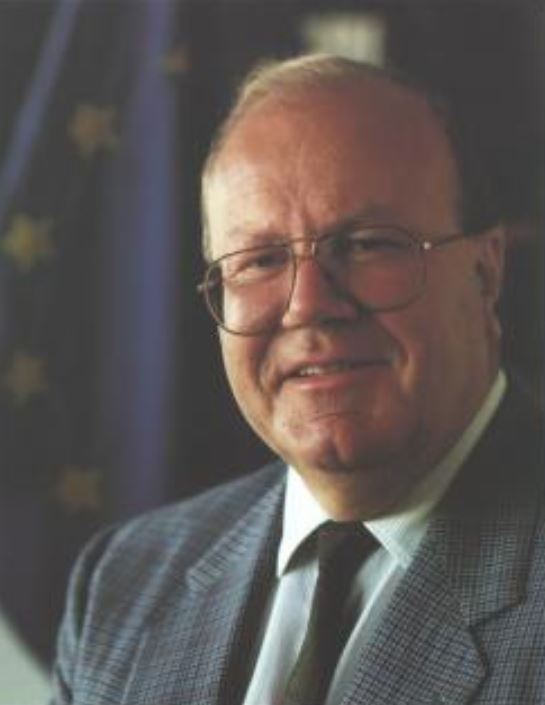
The preparation of standards and verification of compliance were widely used to help home industries and frustrate imports. ETSI was held up by Commissioner Bangermann as the poster child of open standards making or, in his words, the prettiest daughter of the three standards bodies. I have heard ETSI described in many ways but ‘the prettiest daughter’ had me scratching my head. I could only imagine what was going through the minds of my CEN and CENELEC colleagues.
What emerged was the first glimpse that there was not going to be a fortress Europe. The forces of globalisation were just gathering. The political power behind ETSI, through the legal enforcement of ETSI standards, would diminish. ETSI was going to have to sink or swim on its own reputation for delivering the good timely voluntary standards to industry that the market wanted.
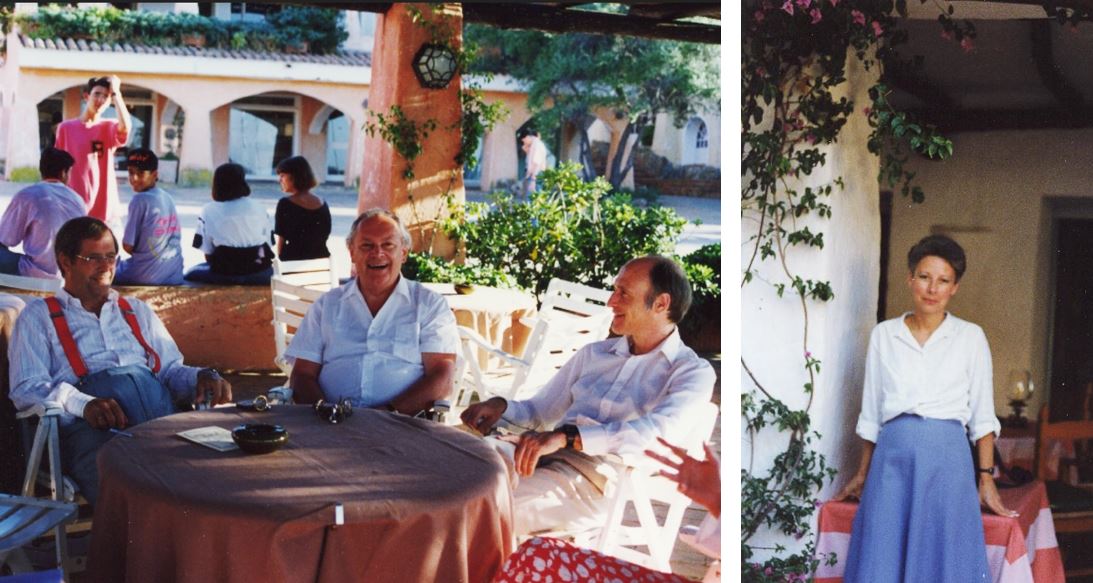
The meeting on Sardinia was one of the most pleasurable I attended during my time with ETSI. The hotel had its own private beach for sunbathing, a pool and top-of-the-range cuisine. Having partners along made it perfect. It is traditional for the older generation to say to the next how much tougher we old folks had it in our young days… I really cannot say that with any conviction after that Sardinia meeting. And for long suffering wives of much travelled standardisation executives (such as my own wife Jocelyne), one trip in four years seemed well deserved thanks for all their support.
At a meeting of the International Telecommunications Union I met Bob Horton from the Australian Administration. He expressed his worry about the build-up of regional standards bodies, like ETSI. He feared Australia getting shut out of standards making. When I got home I thought about this. A lot of countries, like Australia, had historically followed European standards. Why would we want to exclude them and even worse to push them into the arms of another regional standards body? Next time I met with Ib I proposed we should open a class of Associate Membership with a right to participate but not to vote. He agreed. I contacted Bob and he set up a meeting in Melbourne with the head of their telecoms standards committee. I flew out to Melbourne, had a two-hour meeting, and flew immediately back to London… hoping my body clock did not notice anything untoward. It was crazy, but there was so much to do.
When I put the proposal for an Associate Membership to the Technical Assembly there was a mixed reaction. Europe was at the turning point between fortress Europe and open Europe and that was reflected in the discussion. Companies like Alcatel, Ericsson and Siemen’s helped me get this through. The General Assembly then formalised the proposal. It was the start of a truly outward facing ETSI.
Market-led Standards Making
Good timing is indispensable to good standards making. In fast-moving technology, that is very difficult to achieve. Time is often lost in getting the first engagement with making a standard, and that can be lethal as the market fragments with proprietary standards. A valuable innovation was the ‘Strategic Review Committee’. How the idea came about illustrates the strength of the Technical Assembly to come up with something better than the sum of the inputs. The input was a proposal for a forward planning committee. Many hated the idea. In the heated debate that followed emerged the idea of a series of ad hoc review committees, each given a task to focus on a single area where the market was moving rapidly. Its short duration and sharp focus made it easier to find somebody very senior from one of our big members (CTO-type level) to give up their time to lead the review. Their seniority tended to raise the level of representation. They injected fresh thinking. We found some excellent industry leaders to chair these reviews. Every strategic review we did carried authority and was impactful.
Strategic Review Committees were a great help but not the complete answer. In 1991, I wrote a book which ETSI published called ETSI: A Revolution in European Telecommunications Standards Making. (It is a good read for history buffs). In section 4 of the book, I struggled over 15 pages with the issue of market-led standards making. I successfully identified all the issues and defined the boundaries of the problem without ever tying down the solution to my satisfaction. It was a bit of unfinished business when my term as Technical Assembly Chairman came to its end.
Election of a new Director
Prof Gagliardi retired after two years. That was the understanding when he was given the job. The position was advertised. There were three candidates making the shortlist. One was Karl-Heinz Rosenbrock from Telekom in Germany. Another was Peter Hammelberg from the Dutch PTT. A third was Graham Oliver from British Telecom, an excellent standards manager. British Telecom had lobbied ‘a certain country’ to support Graham, and the country had promised him their vote. It will become clearer later why I do not name the country.
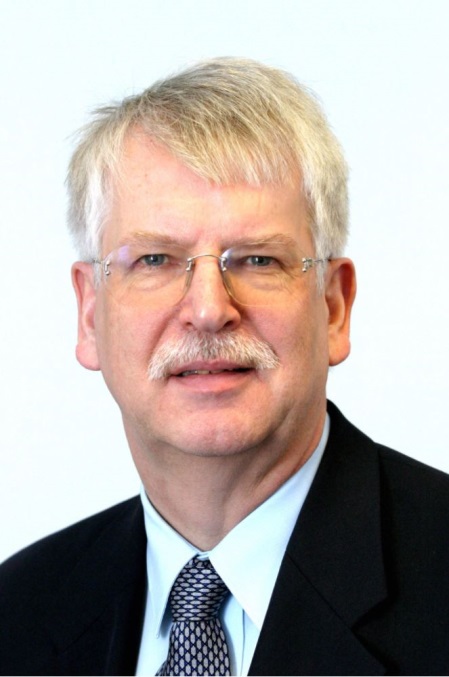
I led the UK delegation to the General Assembly. The election was by secret ballot using weighted majority voting (as in the EU), where I had always imagined the UK had 10 votes. When it came to the first ballot, I was given 10 voting slips. It was an oddity of ETSI’s voting system to maintain secrecy. Naturally, I marked all 10 slips for Graham, in line with the wishes of the UK delegation.
After the first ballot, the person with the least votes was eliminated. It was Graham. He only got 10 votes. The country who had promised to support Graham were seriously embarrassed. I only relate this as a cautionary tale.
The UK delegation then had to decide who to vote for on the second ballot. The UK delegation was absolutely split down the middle, with half wanting Karl-Heinz and the other half wanting Peter. What was I to do? I had ten voting slips in my hand. An inspiration came to me in a flash. I would use five voting slips for Peter and five for Karl-Heinz. It was an absolutely fair reflection of divided UK opinion. When the votes were counted, the outcome of the ballot was an exact 50:50 split in the General Assembly. Like the UK, the ETSI membership were split down the middle between Peter and Karl Heinz.
Events then took a strange turn. I could see a cluster of people around the GA Chairman getting very agitated. By a quirk of arithmetic, it turned out that my splitting the UK vote led to a rare mathematical outcome that was impossible. I went up to Ib and confessed to my crime. He was furious with me, as was everyone else. It was patiently explained to me that the UK only had one vote…with a weight of 10.
The ‘secret’ ballot was to be re-run, and by this fluke of arithmetic and a wheeze of mine that went spectacularly wrong, I became the person deciding who the next Director of ETSI would be. It was a very unenviable position. I did not know Karl-Heinz, but he came highly recommended. I knew Peter and he was capable and well liked. The leader of the German delegation, Peter Kahl, came across and introduced me to Karl-Heinz and then put it bluntly, ‘It is your decision, Stephen’. There was no point in the UK abstaining, as the GA vote would still be a tie and my own delegation was split down the middle. There was no escape. I had to make a fair judgement call on who appeared the best qualified person for the job. I put the UK’s one vote with its weighting of 10 behind Kahl-Heinz. He got the job. This was the second time that ETSI’s destiny had been settled by a quirk of a voting system.
A new Technical Assembly Chairman arrives
The ETSI rules allowed me two terms of two years. I was re-elected in 1990 for a second term. By 1992, my time as ETSI Technical Assembly Chairman had come to an end. It was a symbolic date, as the EU had set itself the political objective of the completion of the European Single Market by the end of 1992. ETSI had been set a political objective of a creating a revolution in telecommunications standards making in Europe. That had been accomplished by a huge ‘team-Europe’ effort. I was really proud of what we had achieved.
The new Chairman of the Technical Assembly was Peter Hammelberg. Just after his election, I entertained him and his wife at my home, where I briefed him fully, answered all his questions and wished him well. But all did not go as well for Peter.
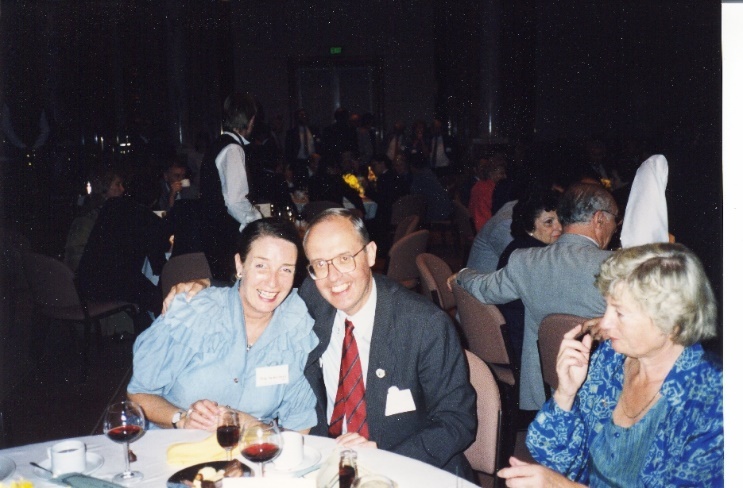
There followed a clash with Karl-Heinz’s ambition to stamp his authority on the direction of ETSI. Karl-Heinz saw my departure as the natural transition point to where the Director, as Chief Executive, would lead the Institute. Peter, it would appear, was not prepared to cede the space. I am told that a power struggle followed. It sowed the seed in many people’s minds that ETSI needed to reform its structure and distribution of power.
High-level Task Force Review of ETSI
In late 2004, I was approached by ETSI to chair a High-Level Task Force to look at ‘how the external environment was likely to change over the next six years and the changes ETSI needed make to meet the new challenges’. But the subtext was that they needed my help, as one of the original architects of ETSI, to bring consensus around closing the Technical Assembly and replacing it with a new, much smaller ETSI Board. I thought long and hard about this reform before accepting the job. The Technical Assembly had one very powerful feature. It was a very open democracy. By getting everyone into the room from every organisation across Europe and everyone being part of the decision, Europe could change direction on an issue very quickly. That was needed for turbulent political times. But ETSI was now well accepted and a well-oiled machine. A more business-like approach was timely. I decided to take the job. My main personal motivation was to help ETSI return to the unfinished task of how to make ETSI nimbler to meet new fast-emerging market needs. This issue was unfinished business for me and it was a huge privilege to have a second chance to find a solution.
There were 44 eminent people who attended the six meetings over a six-month period. The final report was presented to the General Assembly in June 1995. The title I chose for the report was ‘Making International Standards Happen First in Europe’. On the front cover was a picture of a distance runner on a track with an ETSI logo on his T-shirt. It made a few of the multi-national company’s wince. They wanted ETSI’s European roots to be airbrushed out. But I wanted European industry to be self-confident, competitive, outward facing and successful. Europe was in a race with other parts of the world, particularly the Far East. Europe had to get off the block faster for every new opportunity and then run that bit faster to be able to stay in the race.
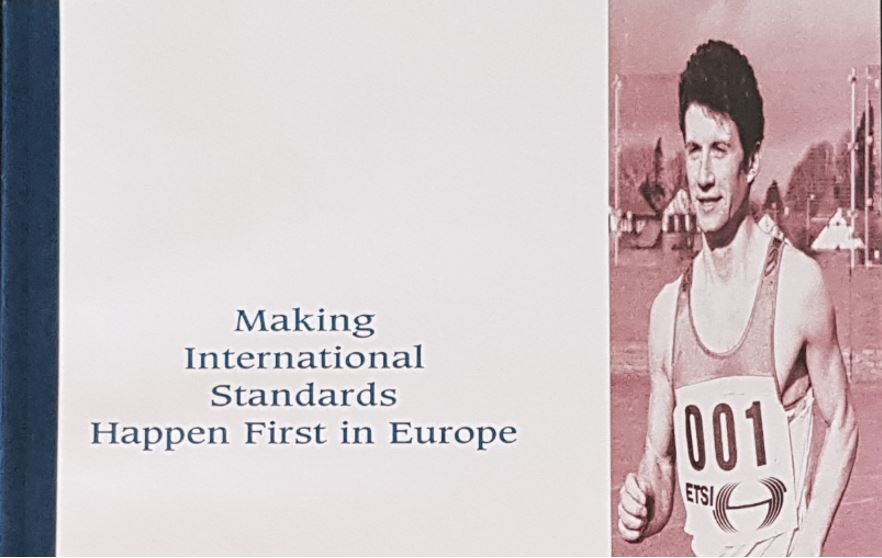
The report was very wide-ranging, but three things stood out. The first was the move from the Technical Assembly to the ETSI Board. The second was a new working structure that created the ETSI Technical Competence Centre. Third was to create, and I quote, ‘a non-bureaucratic presence beyond its circle and foster the informal standards making process at its embryonic stage’. I was delighted how everyone responded when I added this to the agenda. In 2008 ETSI established its Industry Specifications Groups that captured the spirit of the High-Level Task Group idea. ETSI had found a solution to the problem I had been grappling with since 1988 of meshing fast-moving markets with nimble processes that allowed a fleeting standardisation opportunity to be captured on-the-fly.
Retrospective – How well did it turn out?
There was an almost flawless handover of GSM standards making from CEPT to ETSI allowing Europe to dominate cellular mobile for a decade. ETSI also made a powerful contribution to the EU Single Market. Over the next decade it created partnerships that led to the setting up of the now powerful 3G PP standards body that underpins a hugely successful global mobile industry. This has sustained a large membership as access to 3G PP is via one of the regional standards body and ETSI’s open approach makes it a popular gateway. In 2018, ETSI has 800 members from 66 countries across five continents.
A valuable characteristic of ETSI has been its ability to reform itself. The reforms from the High-Level Task Force that delivered the ETSI competence centre and the ETSI Board have stood the test of time. The ETSI of today is probably more efficient and better run than the ETSI of 30 years ago but a shift of emphasis to global standards has meant it has to work much harder to sustain its influence. ETSI is one of Europe’s success stories and well positioned to re-invent itself (again) as and when the next big opportunity arises.