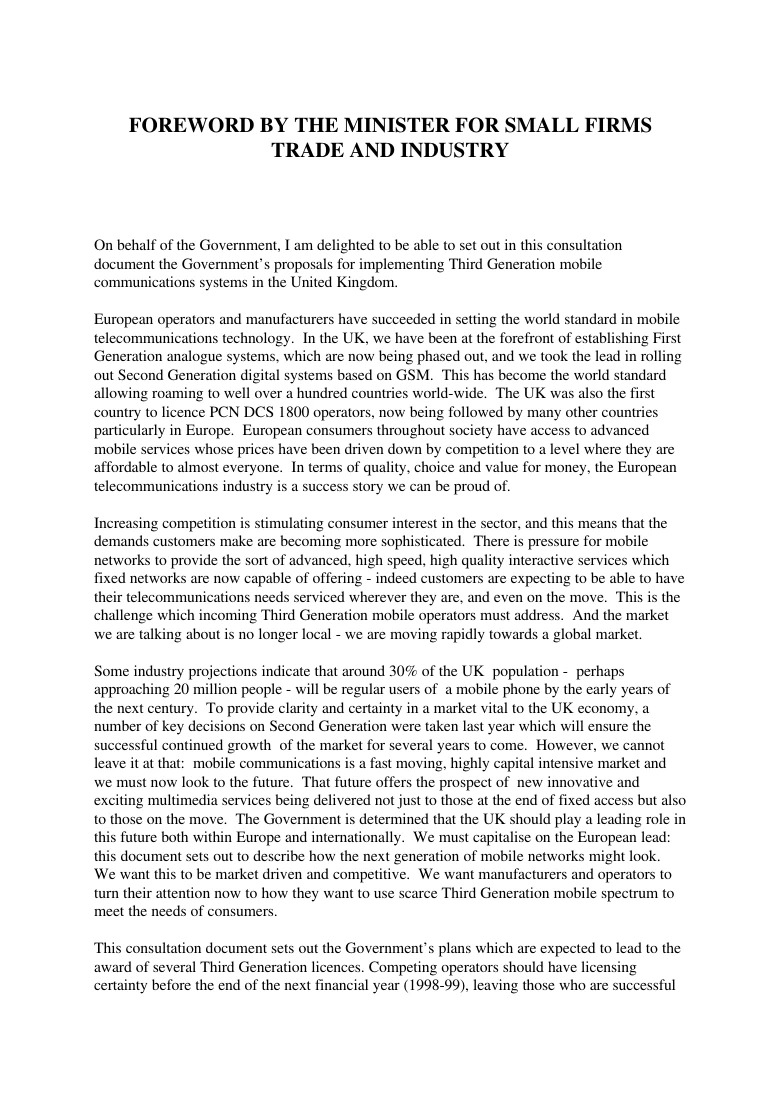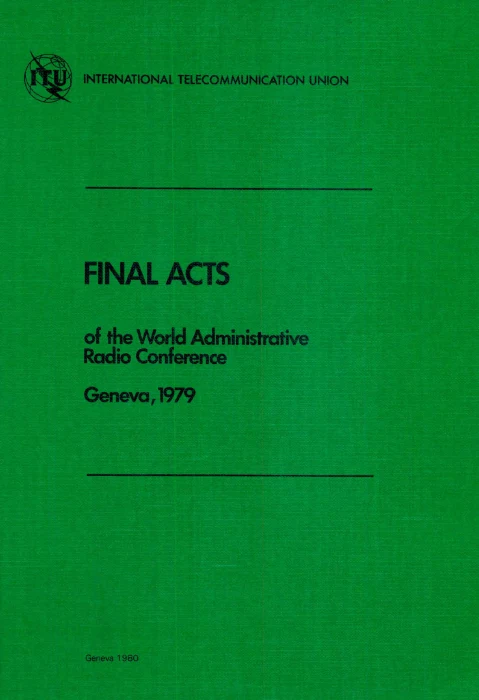
1980 · ITU · Geneva conference, 1979
The Final Acts record the international radio agreements reached at Geneva in 1979. Their frequency-allocation table includes mobile services around 900 MHz alongside existing uses: an important part of the spectrum background to GSM, before a common European system had been designed.
View document→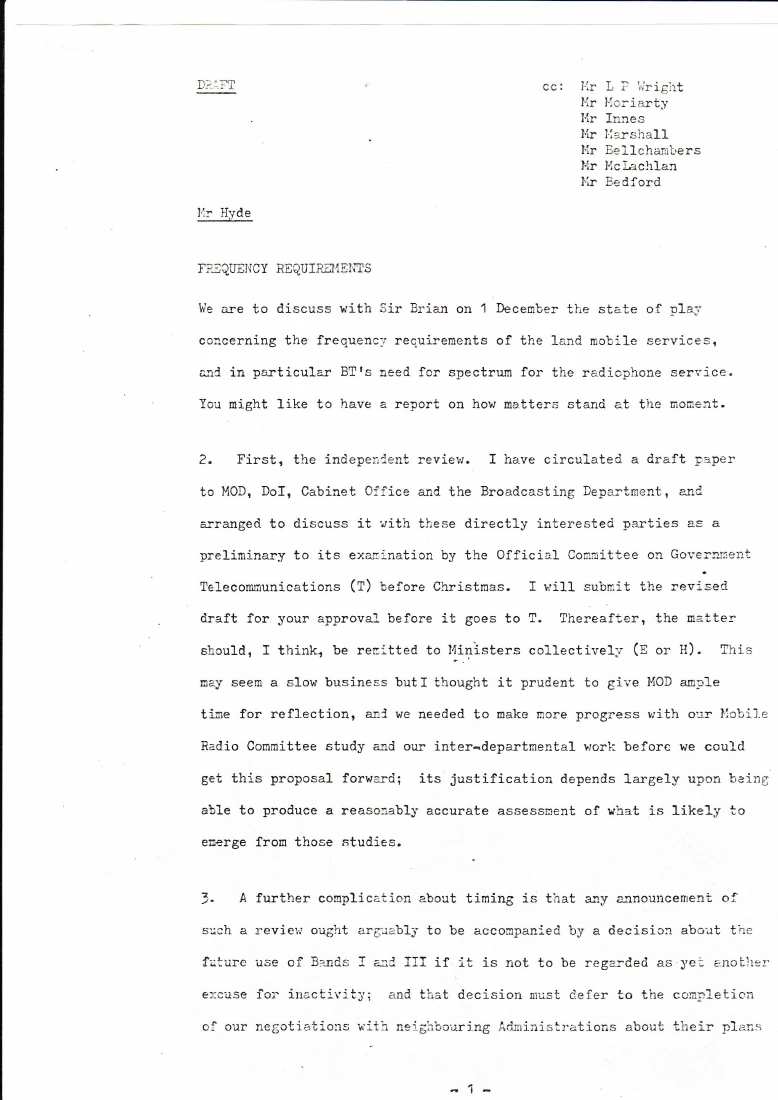
1981 · Internal government minute
The spectrum that mobile networks needed was already the subject of difficult choices before GSM had a name. This Home Office minute considers British Telecom’s demand for radio frequencies alongside military use, broadcasting and the possibility of competition. Officials were trying to anticipate mobile demand years ahead, while confronting questions that a monopoly telephone service had not previously had to answer. The paper preserves those uncertainties in the language of an internal discussion, rather than a later public announcement. It is a revealing starting point for understanding how access to the airwaves helped determine what mobile communications could become.
View document→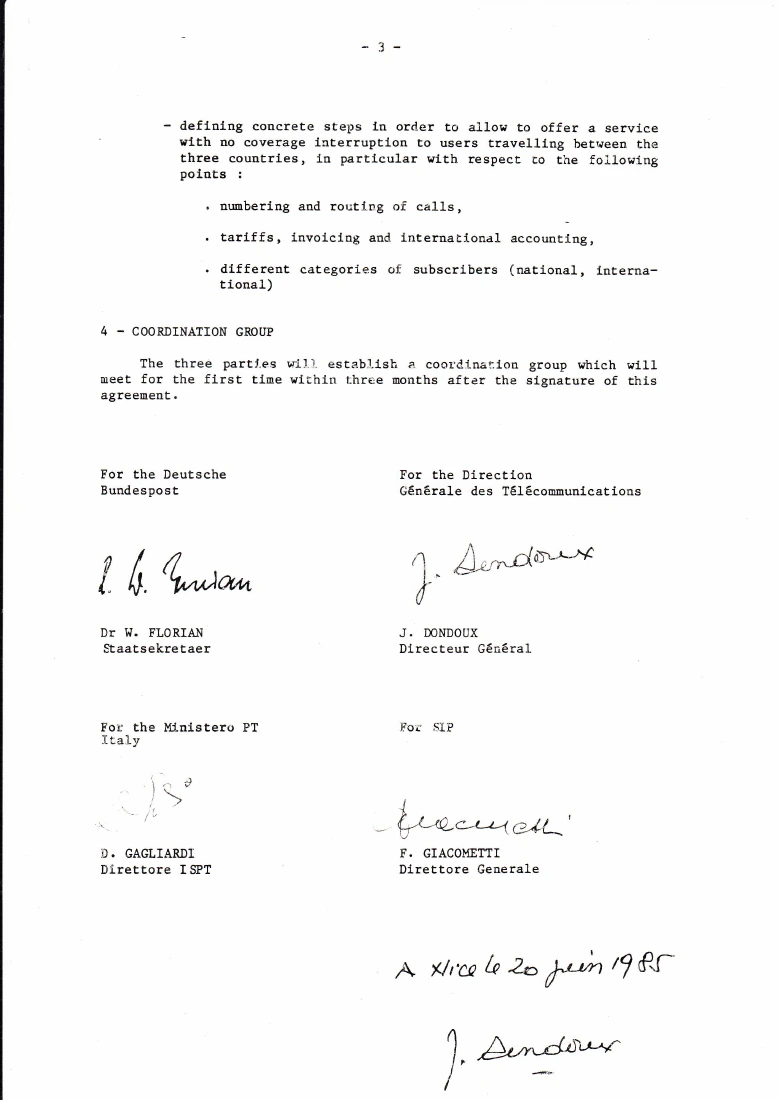
20 June 1985 · Cooperation agreement
A common European mobile service began with a more limited bargain. Deutsche Bundespost, the French telecommunications administration and Italy’s SIP agreed to coordinate research and preparations for compatible digital cellular networks. The agreement envisaged a CEPT standard and left the partnership open to other countries. Its signatures give a tangible form to cooperation that concealed different national priorities: France and Germany were backing industrial development, while Italy wanted a common European system. Britain joined the arrangement the following year. Read the original objectives alongside the three surviving annexes to see how technical experiments, network planning and industrial interests were brought into the same undertaking.
View document→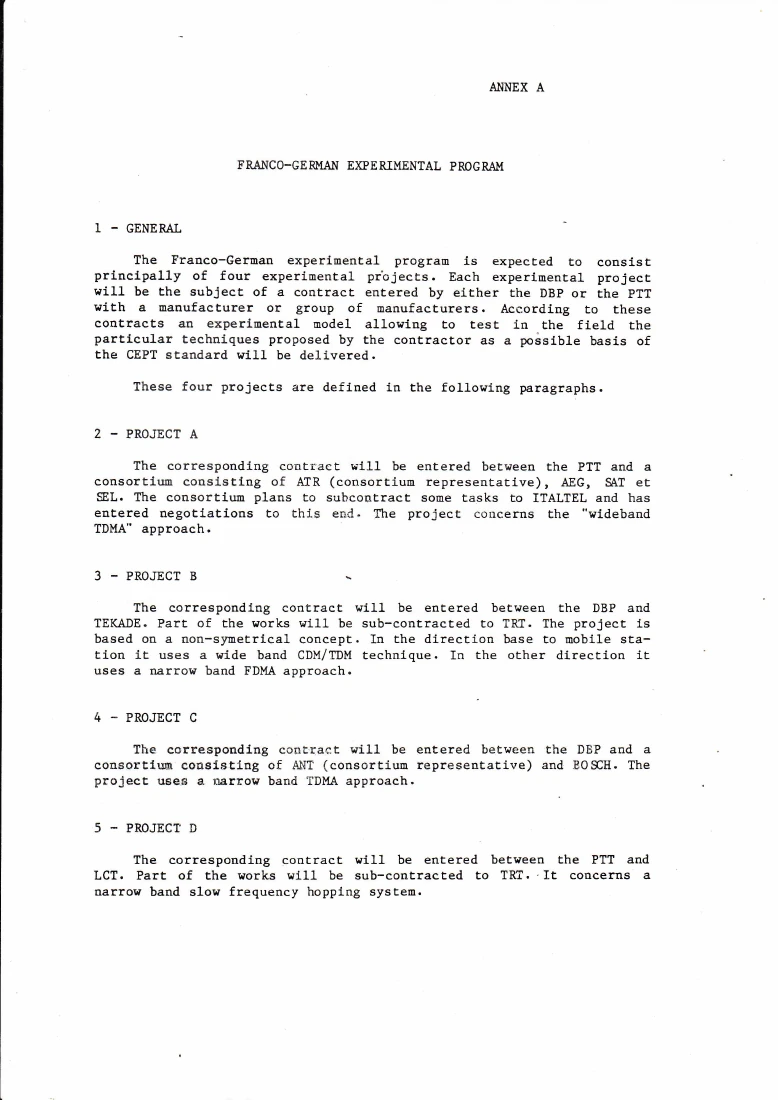
1985 · annex to the cooperation agreement · Research programme
Before GSM settled on a radio system, rival approaches had to be built and tested. This annex sets out four Franco-German experimental projects, naming the manufacturers and consortia responsible for them. Wideband TDMA appears beside narrowband TDMA, a mixed transmission approach and slow frequency hopping. The page captures a moment when the eventual standard was still a choice among competing industrial proposals. It also shows why selecting a technology could never be a purely abstract exercise: contracts, companies and national research programmes already stood behind the alternatives. This is the experimental programme attached to the 1985 cooperation agreement, not a description written after GSM’s success.
View document→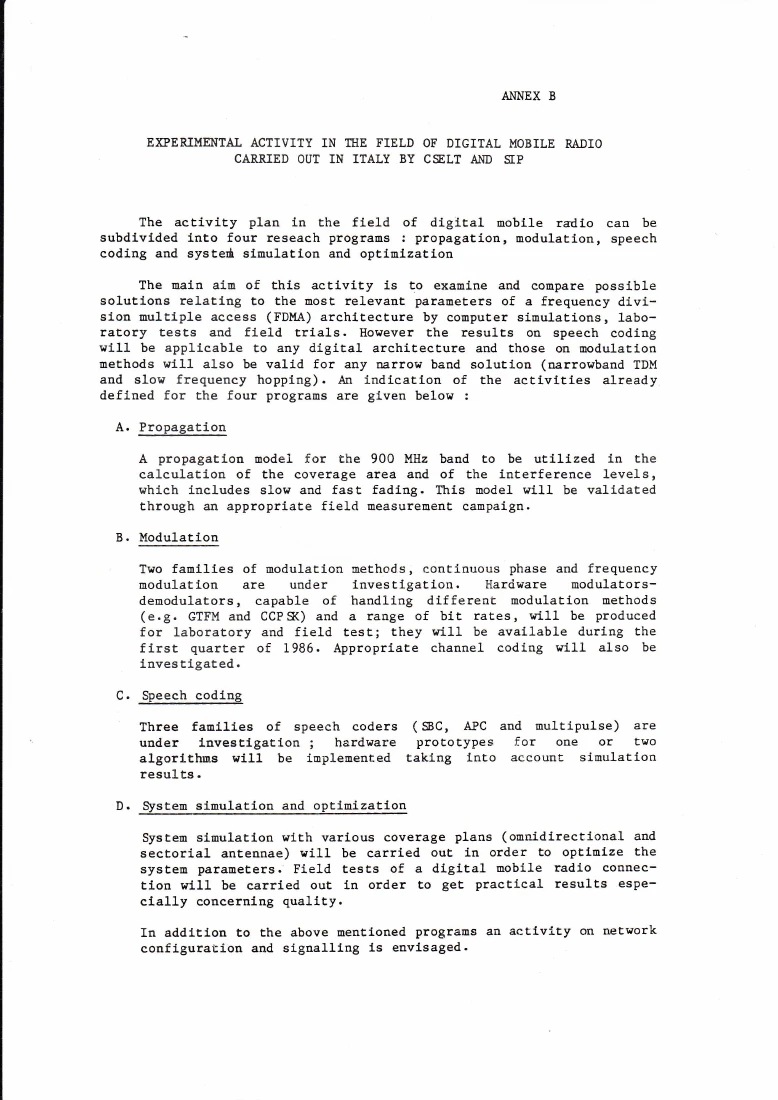
1985 · annex to the cooperation agreement · Research programme
Italy’s contribution to the emerging digital mobile system extended from the behaviour of radio signals to the way speech would be encoded. This annex describes work by CSELT and SIP on propagation, modulation, speech coding and system simulation. It proposes laboratory equipment and field trials, with some hardware expected during the first quarter of 1986. Unlike a finished specification, the programme exposes the questions researchers still needed to resolve. Read beside the Franco-German annex, it reveals the different emphases within the partnership and the practical effort required to turn a shared ambition into a system that could work in real conditions.
View document→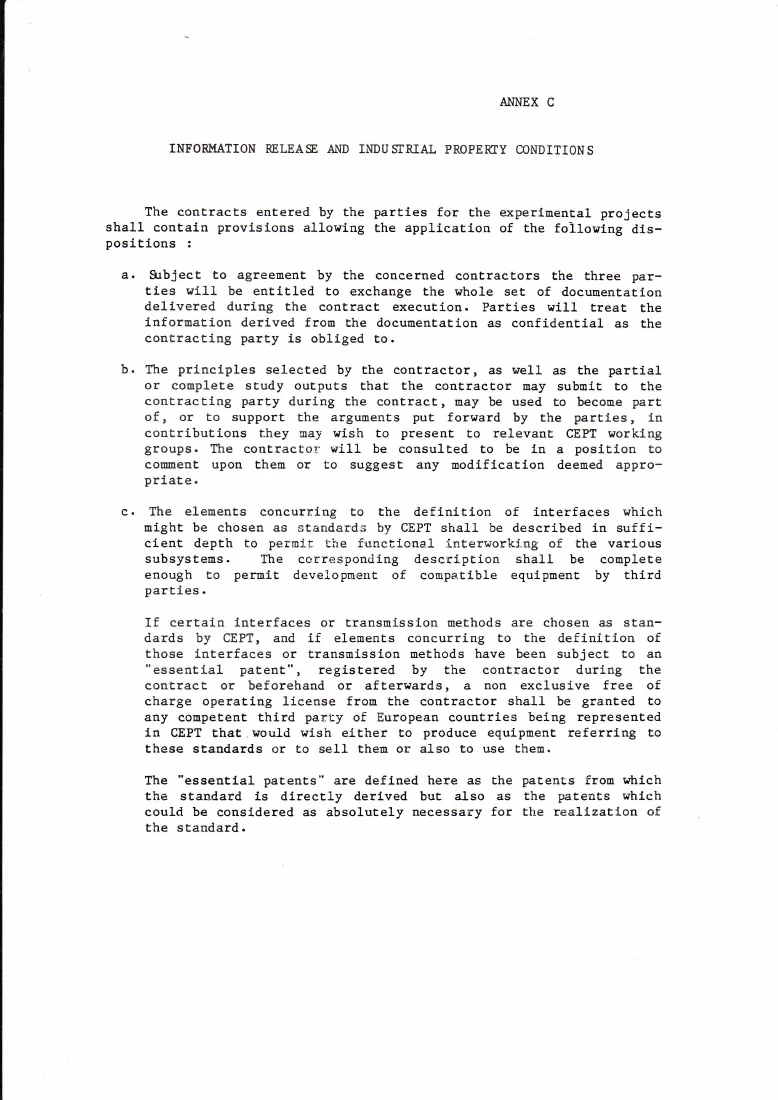
1985 · annex to the cooperation agreement · Intellectual-property conditions
One page reaches beyond radio engineering to a question that would divide the industry: who could use the inventions embodied in a common standard, and on what terms? Annex C defines conditions for exchanging research information and making compatible equipment. It envisages free, non-exclusive licences for essential patents under the stated conditions, available to competent third parties in European countries represented in CEPT. Stephen Temple’s archive account connects this approach with the later clash over intellectual property at ETSI. The document makes that fault line visible early, when a promise of interoperability also raised difficult questions about commercial rights and rewards.
View document→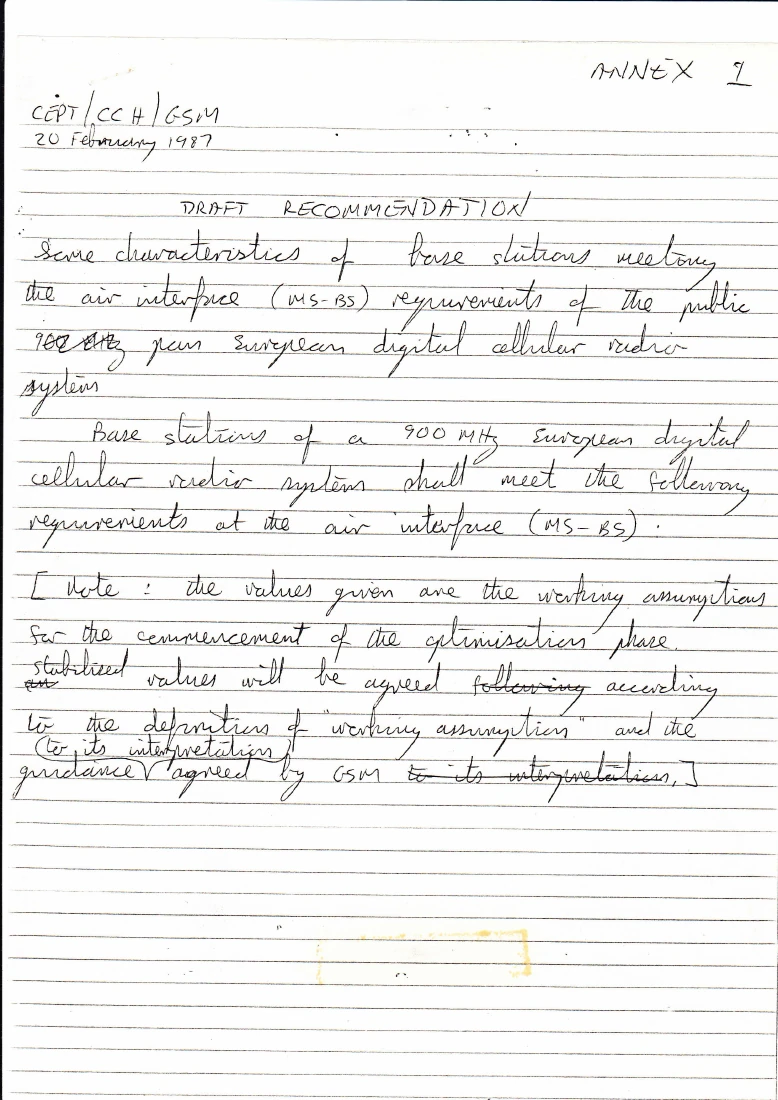
16–20 February 1987 · Technical working papers
The Madeira meeting is remembered for failing to settle the contest between wideband and narrowband radio systems. These working papers preserve the less obvious achievement. Delegates developed a set of narrowband working assumptions that could carry the technical work forward, even while the wider argument remained unresolved. Typed decisions sit alongside handwritten parameters and amendments, showing a standard taking shape through negotiation rather than appearing fully formed. The opening draft identifies the meeting of 16–20 February 1987. These are the surviving papers behind the archive’s account of an important technical compromise, whose details would still be altered when ministers reached their political agreement in Bonn.
View document→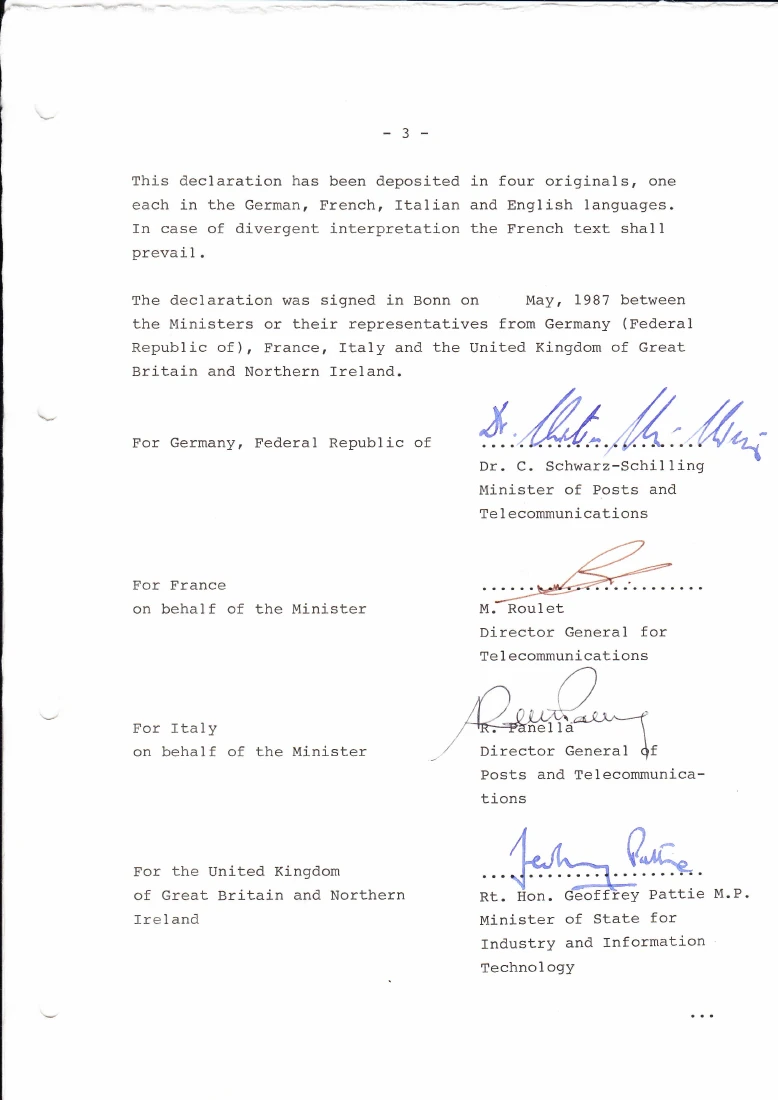
19 May 1987 · Ministerial declaration
Four governments put their authority behind a common European mobile system at Bonn on 19 May 1987. The declaration records agreement on the technology and measures needed to open services by 1991. Crucially, it called for an operators’ Memorandum of Understanding: political agreement alone could not build the networks or secure the investment. The surviving signature pages bring ministers, officials and operators into the same record. Stephen Temple describes the negotiations behind this apparently ceremonial moment in both books. The archive identifies this as the UK government’s copy, whose original is held by the Science Museum in London.
View document→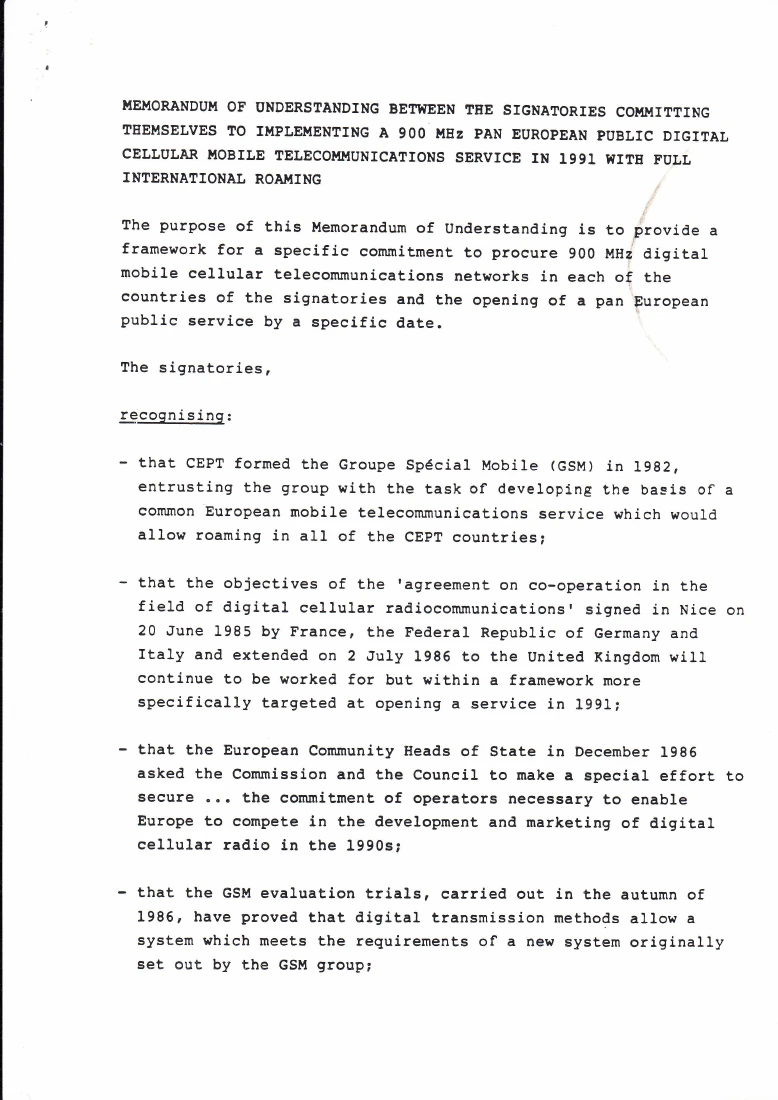
7 September 1987 · Memorandum of Understanding
A technical standard needed networks, investment and services that would work across borders. The GSM Memorandum of Understanding turned that ambition into a framework of commitments among its signatories. Dated 7 September 1987, it addresses procurement, international roaming, open interfaces and the coordinated introduction of a pan-European service in 1991. This is the copy Stephen Temple’s archive records him taking away from Copenhagen after the signing. Its articles show how governments’ political support was translated into obligations for the organisations that would implement the system. The accompanying signature collection reveals the people and administrations behind those commitments.
View document→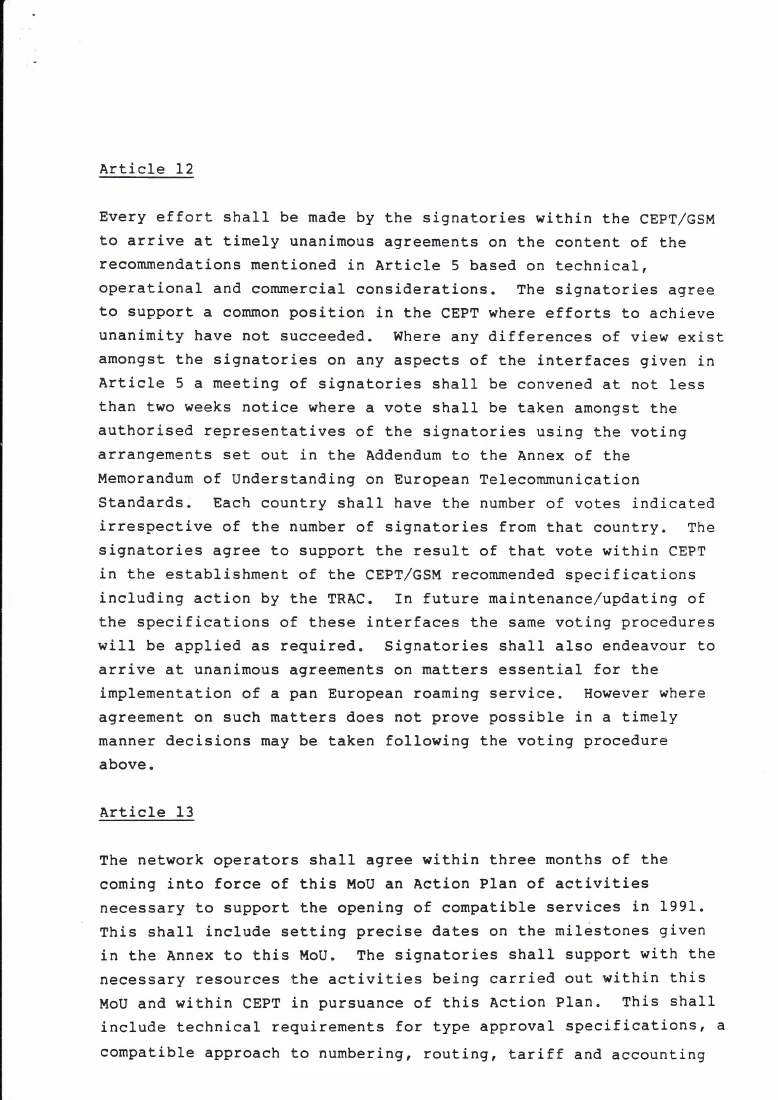
7 September 1987 · associated MoU · Annex archive record
Opening a European mobile service required more than agreement on a technical standard. The archive describes an annex to the GSM MoU setting out network implementation phases and related milestones, linking the shared ambition to a practical timetable. The MoU itself requires its signatories to work to an implementation plan. There is an important limitation in this surviving online record: the file originally linked as the milestones annex is identical to the nine-page MoU and does not contain a separate annex. It is retained here exactly as supplied, with the relevant implementation-plan article visible, so readers can distinguish the documented commitment from the missing annex itself.
View document→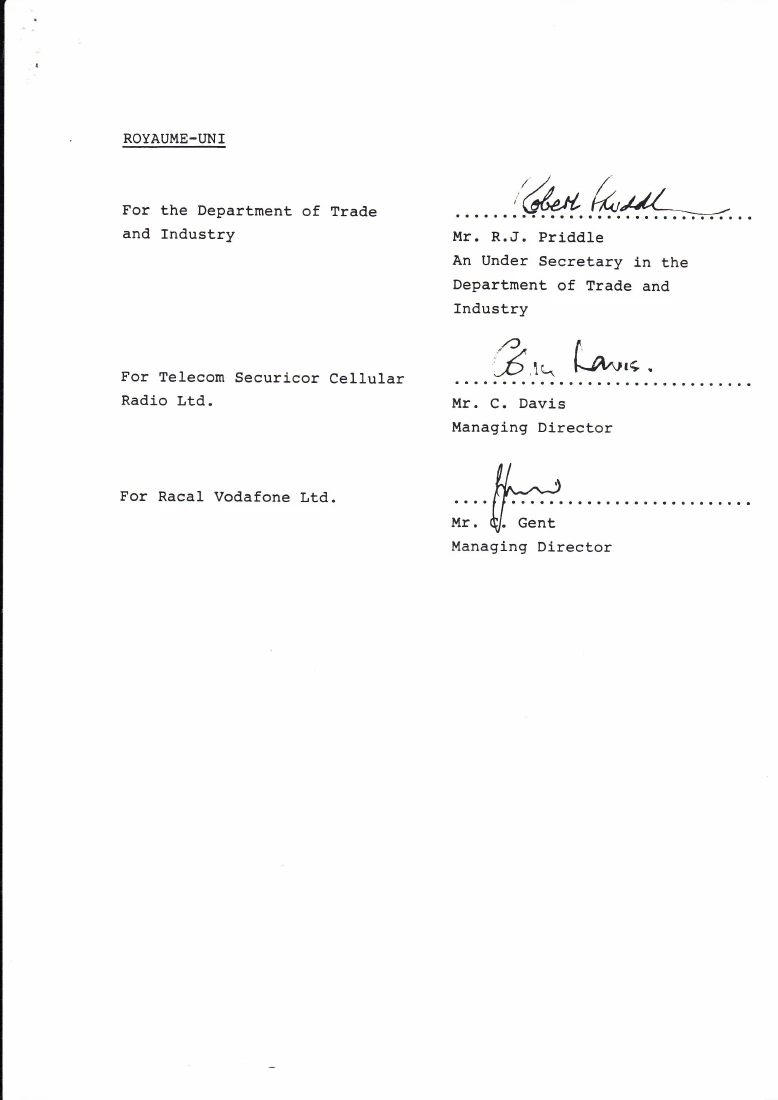
September 1987 · Signed agreement pages
An international agreement becomes concrete when names are put to it. These pages preserve the signatures associated with the GSM MoU, with each administration or operator identified on its own sheet. The collection opens with the Copenhagen signing of 7 September 1987 and includes Spain, which the archive account says joined about a week later. The UK sheet brings the Department of Trade and Industry together with the two competing network operators. Seen as a group, the pages show how a European initiative gathered commitments across national and organisational boundaries. They complement the MoU’s articles with a record of who undertook to put them into practice.
View document→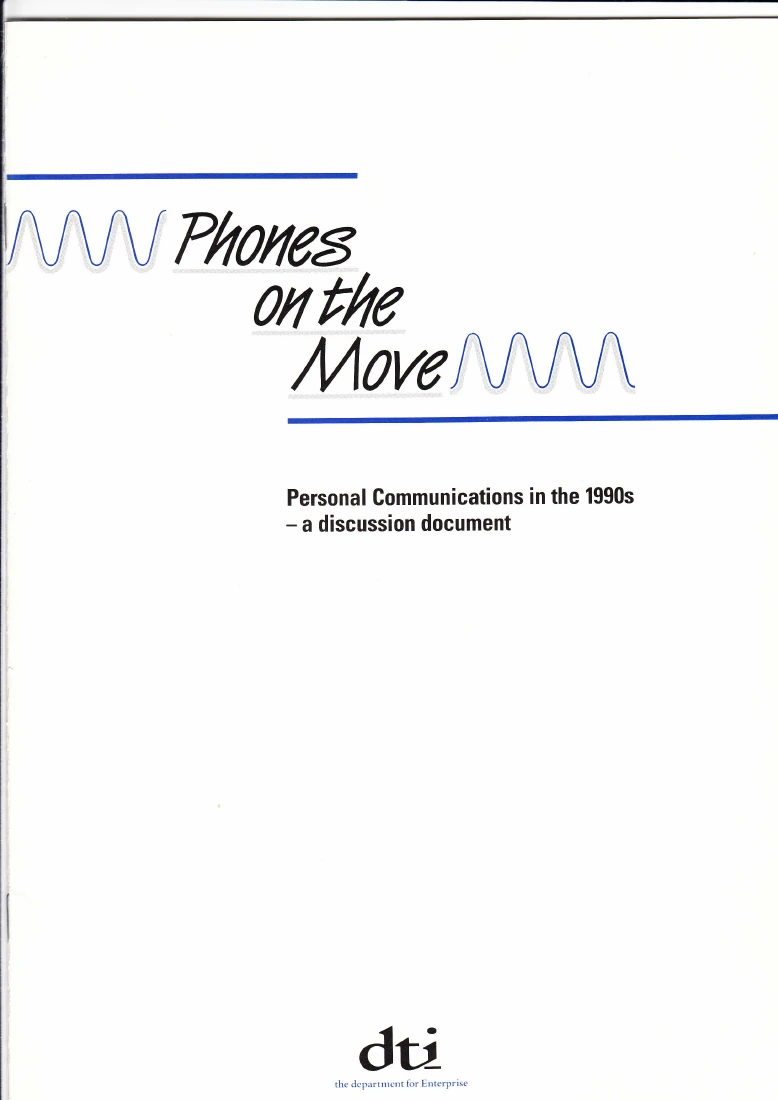
January 1989 · DTI discussion document
What would happen if mobile communications were designed for people carrying small handsets, rather than mainly for motorists? This Department of Trade and Industry discussion document put that prospect into a practical policy debate in January 1989. It considered new networks, competition and spectrum around 1800 MHz, with digital cellular technology as a route towards personal communications. Its questions invited industry to respond before the shape of the market was settled. Stephen Temple’s account explains the speed with which the document was prepared and the tension it created with the competing Telepoint initiative. The original preserves a policy choice at the point when it was still an invitation to act.
View document→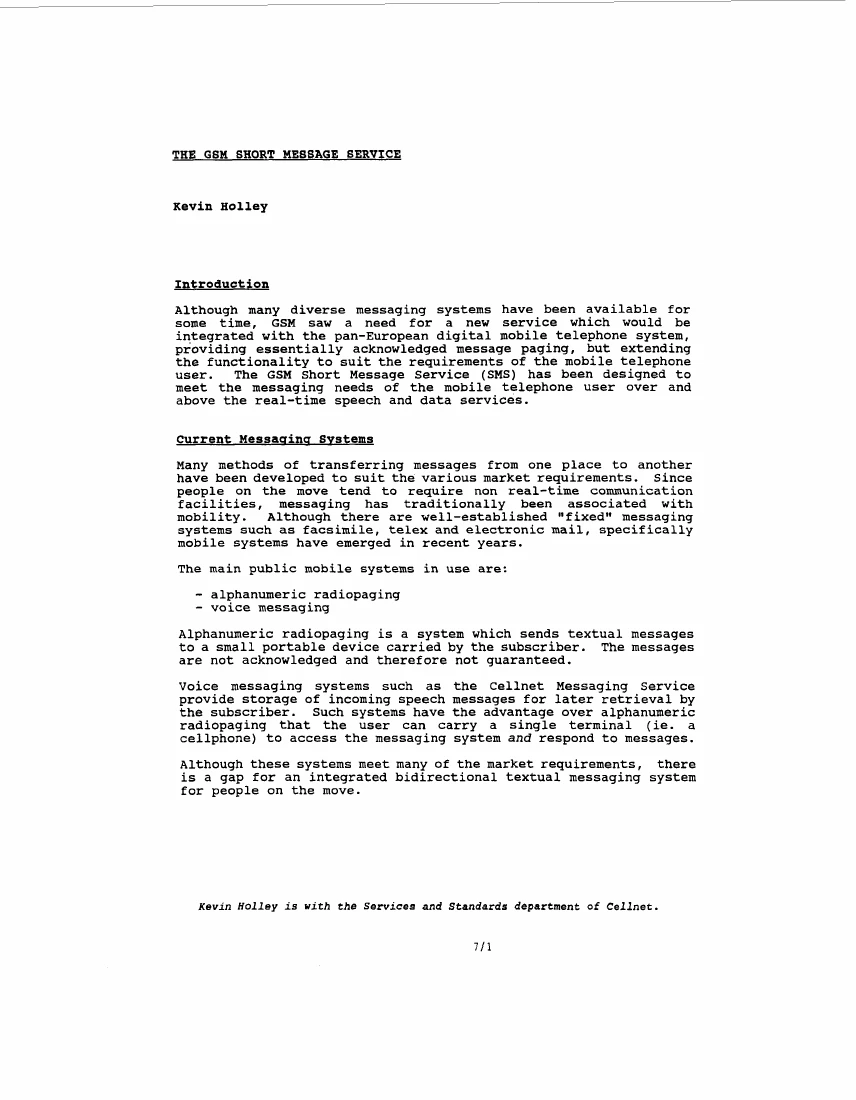
January 1991 · Technical paper
Kevin Holley’s paper describes the GSM Short Message Service, its development and its technical operation. The Fathers of SMS account records its presentation at the IEE Colloquium on GSM and PCN Enhanced Mobile Services in January 1991, before the first SMS message was sent.
View document→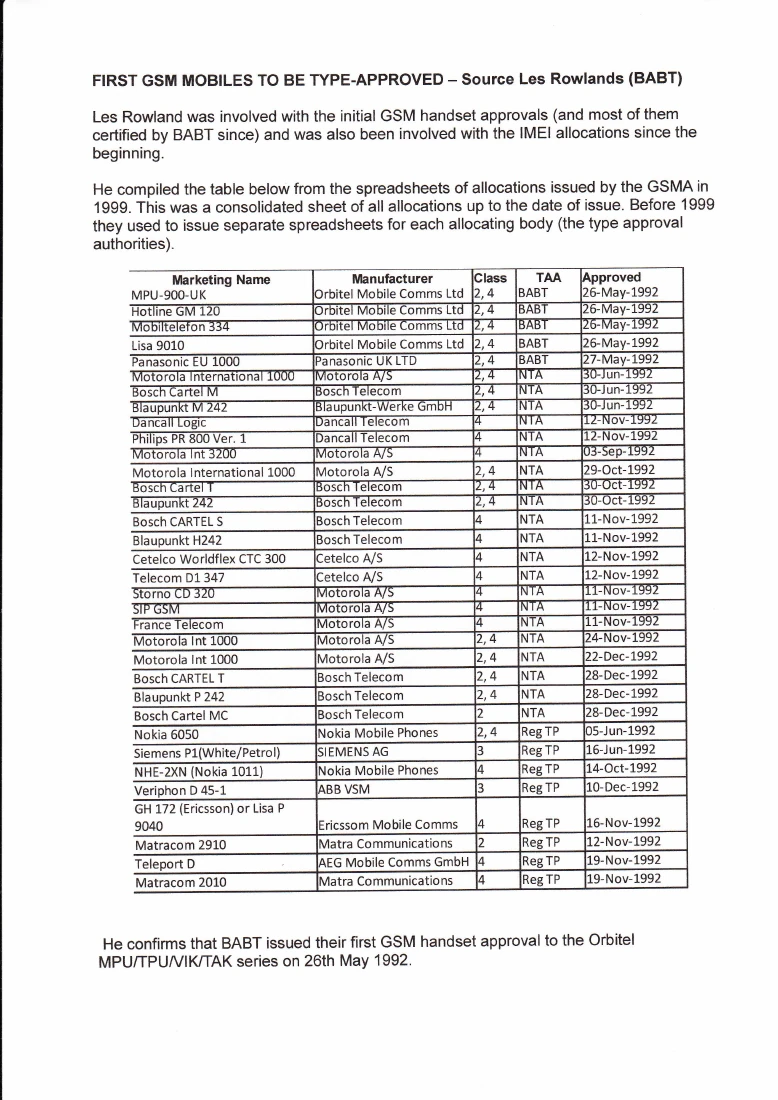
Compiled in or after 1999 · records 1992 approvals · Retrospective approval register
Networks were ready before approved GSM handsets were available to their customers. This register helps trace the eventual arrival of those phones, listing manufacturers, models and approval dates. Its introductory note credits Les Rowlands of BABT and explains that the table was compiled from GSMA allocation spreadsheets issued in 1999. It is therefore a later record of the early approvals, not a sheet produced in 1992. The closing note identifies BABT’s first GSM handset approval as 26 May 1992 for the Orbitel series. That distinction matters: the table is useful historical evidence, while its own account tells us how and when the evidence was assembled.
View document→
14 September 2016 · COM(2016) 588 final
In September 2016, the European Commission called for a coordinated European launch of 5G and proposed identifying pioneer spectrum across three frequency ranges. The Action Plan captures the political commitment behind the emerging European approach to 5G spectrum.
View document→
9 November 2016 · RSPG16-032 FINAL
The Radio Spectrum Policy Group’s November 2016 opinion records the spectrum recommendations behind Europe’s 5G pioneer-band strategy. It explains the choice of complementary frequency bands for coverage and capacity, following the difficult negotiations described in Stephen Temple’s eyewitness account.
View document→
2021 · Institution of Engineering and Technology (IET)
What should governments seek to achieve with 6G? Edited by Professor Stephen Temple, this IET guide considers societal goals alongside spectrum, regulation and international cooperation. It offers a starting point for policy debate, rather than a settled technical blueprint.
View document→
November 2023 · ITU-R M.2160-0
What has been agreed internationally about the direction of 6G? Recommendation ITU-R M.2160-0 sets out the framework and overall objectives for IMT-2030. It provides a common basis for future development, not a completed 6G technical standard.
View document→
June 2025 · University of Surrey, 6G Innovation Centre
What improvements do operators need—and what can they afford? Developed with UK mobile network operators and industry, this working vision focuses on more reliable coverage, AI-ready infrastructure and economic realities. It proposes a direction for future networks rather than reporting an agreed deployment plan.
View document→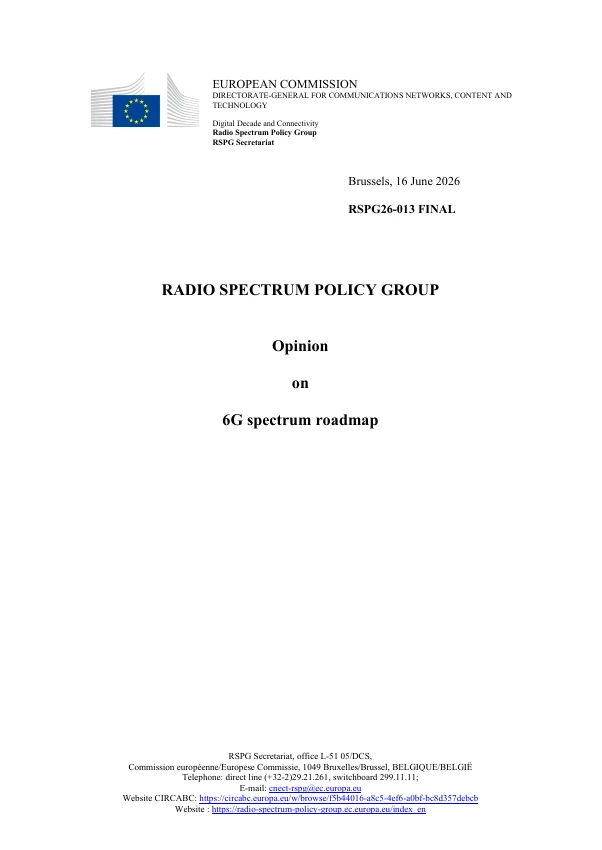
16 June 2026 · RSPG26-013 FINAL
How is Europe preparing spectrum policy for 6G? This RSPG opinion sets out a developing roadmap of frequency ranges and regulatory work. Read it alongside the earlier pioneer-band debate as recommendations for future decisions—not final spectrum assignments or evidence of commercial 6G deployment.
View document→