Chapter 35
THE TEN RULES
SECTION B – CONCLUSIONS
TEN RULES FOR POLICY MAKERS TO KEEP A NATIONAL TELECOMMUNICATIONS INFRASTRUCTURE WORLD-CLASS
My list of the five biggest UK telecommunications policy successes over the past three decades would be:
- Mobile Network Competition
- GSM (which began as a pan-European initiative)
- Digital Television (Satellite, Terrestrial and Cable)
- Broadband Internet
- Single Market (with initiatives like the European Telecommunications Standards Institute (ETSI)
….and the five biggest disappointments:
- Fixed Network Competition
- Digitalisation of the Plain Old Telephone
- Mobile coverage
- Intellectual Property Rights (within technical standards)
- Digital Audio Broadcasting (DAB)
That is the past. What of the future?
Every age brings its own unique challenges, but some rules remain timeless for large infrastructure transformations, particularly in telecommunication, with its intricate pattern of global connectivity and long lead times. What are the conclusions that can be drawn from this public record of how we shaped our digital networks over the past 30 years that could inform future initiatives?
RuleRule 1 1 – ‘Success requires agendas to be aligned, a smart mix of cooperation and competition and going with the flow of the market.’
How does a country or company become a leader in the next wave of communications technology? There is no better place to look than the approach taken for the Global System for Mobile Communications (GSM) – one of the most successful collaborative technology initiatives ever undertaken by Europe.
Cooperation dominated the incubation period of GSM, bringing together competitors at both the mobile operator and vendor levels, with governments and the EU Commission playing a facilitating role. Competition dominated the post-launch period. It unleashed enormous energy. It was the new entrants that did the heaviest lifting to get GSM off the ground in the first 18 months.
The complete picture was assembled:
- Market Need
- Bringing Technology Innovation within a Common Standard
- A Suitable Spectrum Band
- A Supportive Regulatory Framework
This was more than a checklist. It was vital for each of these to fit perfectly with the others. Agendas had to be aligned. Political endorsement of a credible vision was helpful in achieving this. This strategy of “disruption by consensus” delivered one of Europe’s most successful digital infrastructure projects and lifted Europe to a position of global leadership in digital cellular technology that lasted for a decade.
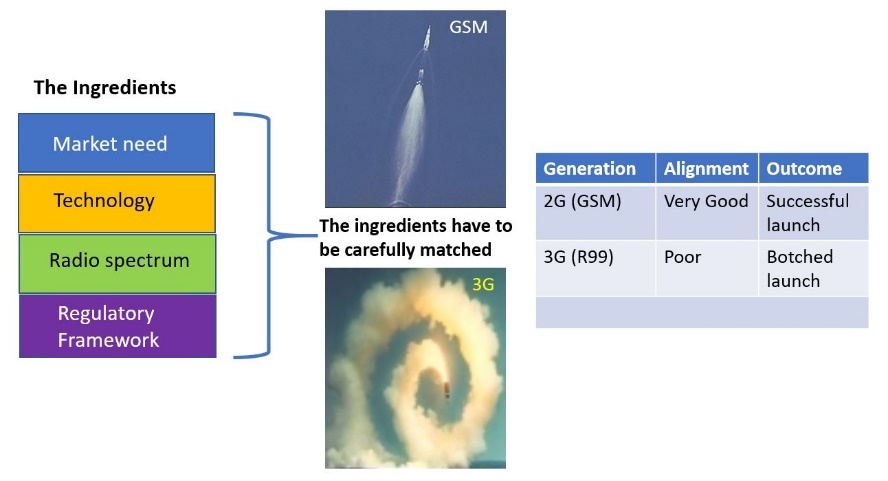
When 3G came along, governments had come to believe the market alone could do a better job and disengaged. The mobile operators took a back seat in the standards bodies and left the running to the vendors. The only thing that was correctly identified was the market need. Everything else was a mismatch. The 3G technology (Release 99) delivered by vendors did not deliver anything like the 2 Mb/s the mobile operators thought they would get when they bid for their spectrum. It was more like 384 kb/s. The choice of spectrum band (2.1 GHz) was not suitable for reliable national coverage. The new regulatory approach was to suck money out of the mobile industry for the Treasury. The coverage obligation was lax and led to enormous consumer dissatisfaction. 3G had to be re-launched five years later with High Speed Packet Access (HSPA), and some argue that 4G has been the real re-set together with the release of the 800 MHz band. Even that arrived late in Europe. Markets alone failed to deliver a timely and effective cellular infrastructures outcome and lost Europe its leadership in cellular mobile.
2G (GSM) and 3G are the perfect case studies of how to do it and how not to do it. Success required a smart mix of cooperation and competition within an intervention that goes with the flow of the market. I always used to imagine the market as a fast-flowing river, where a government should not try to dam the flow and certainly not try to make the water flow uphill (bucking the market). What it could do was direct the flow so many degrees to the left or so many degrees to the right to harness the flow to generate enormous public good.
The research community will often be the source of technology change, but the research community can get too carried away with technical purity. A key role of senior engineers in government, regulators and standards bodies is to find the optimal point of balance of technical ideals, market forces and political realities.
Rule Rule 2 2. ‘Control of the radio spectrum is one of the few effective tools a government has to secure better wireless infrastructure.’
Control of the radio spectrum was central to the success of GSM and digital TV. The use of spectrum as a tool to achieve public policy objectives was swept out of fashion around 2000 by a new economic theory, mentioned earlier. It led to an ideological battle between what Ofcom pejoratively termed the old ‘Command and Control’ approach to managing spectrum and a new ‘market-oriented’ approach. Economists, knowing nothing about the cellular mobile industry, argued that spectrum use should be left entirely to the market. Spectrum auctions emerged as the preferred way to release new spectrum. The theory of spectrum auctions is that the highest bidder is likely to make the best use of the spectrum. Pricing spectrum was also going to lead to a spectrum-trading market that would offer a fast route for innovators and new entrants to gain access to spectrum. It was claimed that new freedoms for mobile operators to use their spectrum for the technology of their choice would allow a faster transition to a next generation of technology.
All of these claims have turned out to be illusionary. All of them. A spectrum-trading market has failed to materialise, and there appears no correlation between what a mobile operator pays for spectrum at spectrum auctions and the economic benefit to the country. For example, auction theory would have it that Vodafone would have made the best use of its 3G spectrum, having paid by far the most for it. In practice, Vodafone did relatively little to help get 3G off the ground and lagged on 3G coverage thirteen years after the auction. Their spectrum lay unused over much of the country. The underlying supposition economists made of an alignment of company and country interests turned out to be misplaced. Sucking so much money out of the mobile industry at the 3G auction had adverse consequences for the investment in the next generation infrastructure.

A faster transition to a next generation of technology did not play out with 4G in the manner claimed. The UK (and Europe in general) was very late in rolling out 4G. It was widely recognised by 2016 that the market approach would fail completely with 5G, as there were no spectrum holdings in the market able to support the wide radio channels 5G needed. The experiment in the market-oriented approach to spectrum for national infrastructures over promised, seriously under delivered and is now quite the wrong approach in a digital age where so much of the economy and social life now depends upon a constant up-grading of the national wireless infrastructures. Ensuring that happens is the role of government and not the role of shareholders of private multinational companies.
Mention was made at the beginning of the section that mobile coverage has been one of the big policy disappointments. Mobile coverage obligations attached to spectrum licenses have had a chequered history:
In the GSM (2G) licences there was a national roaming obligation put in by the DTI (my first job in the DTI). The two mobile operators convinced Oftel that it was getting in the way of competition delivering better coverage. The regulator removed the obligation but in solving one problem (that could have been solved with a coverage obligation) they created a more enduring one – partial not-spots (large numbers of locations where consumers do not get contiguous coverage even though a signal from another operator is present). The “partial not spot” problem could be solved at a stroke by the mobile operators switching-on “national roaming”. Everybody in the entire country loves the idea…except the mobile operators. It must be some sort of forgotten trauma they experienced somewhere along the way, as there appears no rational reason for their deep-rooted objection…they could even make money from it as a premium service.
In 2000 the 3G licenses included coverage obligation requiring the mobile operators to cover 70% of the population. It was far too weak. In 2010 the Government directed Ofcom to increase this obligation further, requiring operators to cover 90% of where the UK population lives. The policy flaw was in specifying the obligation in terms of where people live whereas mobile connectivity is, at its most indispensable, where people travel to and from their homes and places of work.
In 2013 one licence for 800MHz spectrum had an obligation for 98% of the population and 95% of the geographic area of the nations but the full impact of the geographic coverage was weakened by only requiring it for 90% of the time and in non-busy periods.
The worst policy decision of all came from local “planners” imposing a 15m height restriction on masts (the lowest in Europe), with the result that surrounding trees weaken the mobile phone signals, particularly for the higher capacity spectrum bands. Over the years the trees have grown taller but the mobile mast height remained the same. There have been recent steps by government to ease this limit but the UK has been left with a legacy of insufficient mast heights in wooded or undulating terrain.
Mobile coverage has been a sad story of “too little too late” and there is a huge legacy of problems to put right, even before policy makers have to start all over again with the coverage of “Gb/s on the move”.
Responsibility for ensuring a continuously improving national wireless infrastructure to maximise economic benefits (including industrial strategy and innovation) and powers over the use of radio spectrum to achieve this have to be aligned. One of the structural barriers still existing in 2018 is that, either Ofcom’s duties were too narrowly defined (consumers and citizens) or the governments direct powers over radio spectrum for public wireless infrastructure were left far too weak. A high performing model would see government setting new spectrum policy and the independent regulator delivering it in a transparent way.
Rule Rule 3 3. ‘If Governments are to intervene, they must intervene comprehensively.’
When governments announce a policy intervention, everyone will ask the obvious question: is it feasible? What often does not get asked are the two follow-up questions: what are the conditions that need to be in place to ensure the intervention succeeds, and is the government willing to create those conditions? This is the danger zone for big interventions. Ministers are easily attracted to the prize but are often not willing or are unable to deliver the means. Perhaps the supportive actions clash with the agendas of other departments, the Treasury are obstructive, or the independent regulator won’t play ball. The result can be ‘the half-hearted intervention’. It can lead to the worst of all worlds – all the market distortion of an intervention but not enough to reach a tipping point. Some fail, and others finish up paralysed halfway down the track – too successful to be scrapped but not successful enough to ever achieve the ultimate goal. The introduction of fixed network competition in the UK is one of the best examples of a stalled government intervention. Digital Audio Broadcasting (DAB) is another.
The same rule applies to private sector interventions. The classic industry example of the half-hearted intervention was the Cable and Wireless Board decision to slash the investment Mercury One-2-One could spend on their initial GSM 1800 mobile network roll-out. The Board wanted the outcome but were not prepared to supply the means. Instead of providing near national coverage at launch, as Orange did, they only authorised enough money just to cover London. The company never recovered from this half-hearted intervention.
Rule 4 – Rule 4 A world-class fixed digital infrastructure needs a world-class regulatory framework that geographically differentiates where competition works and where it doesn’t.
In the 1980’s the UK Conservative government leapt into introducing competition in the telecommunications fixed and mobile infrastructures on a wave of ideological belief. “More infrastructure competition” became the regulatory policy end-goal. The rest of Europe looked on with a sceptical eye. Telecommunications networks were believed to be natural monopolies. Within two or three years of observing how things were unfolding in the UK, the rest of Europe came to a view that mobile network competition would work, but fixed network competition was problematic. The UK government and Oftel continued with both, regardless. The mobile network competition turned out to be highly successful, but the fixed network infrastructure competition stalled halfway.
Three decades later the UK struggles with the consequences. In 2018 the UK found itself with only 4% of homes with full fibre compared to Portugal with 89%, Spain with 71% and Japan with 97%. There are three main reasons for this:
- The UK became two countries in terms of competitive market structure. The Virgin Media cable and telephone wireline network offers an alternative wireline connection in around half of the country (the best demographics). The other half (the worst demographics), for the most part, only has BT’s Openreach copper wires. Ofcom has been applying a geographically undifferentiated national regulatory policy that is neither optimised for one nor the other market structure.
- The existence of a cable TV network effectively created an intermediate technology (coaxial cable) between copper wire and full fibre. This reduces the step change improvement full fibre brings over copper wires. (Germany shares a similar characteristic).
- A host of complex barriers that put up the cost of rolling out full fibre, such as wayleaves, planning etc.
If the national objective is to universally up-grade the UK’s fixed infrastructure from copper to fibre, then infrastructure competition can no longer be the sole regulatory policy end-goal. A world-class fixed digital infrastructure becomes the prime objective and needs a world-class regulatory framework that geographically differentiates between where competition works successfully and where local demographics make it untenable.
Rule 5Rule 5 . ‘Telecoms thrives on “Standards”.’
The challenge since liberalisation has been to match slow-moving standards processes with fast-moving technologies and markets. A successful balance has been found in telecommunications infrastructure largely because the networks have such a huge inertia. The trick has been to synchronise the start points that create the entry for updating the technology – which is why the mobile industry has this unique ‘generational’ cycle every 10 years or so.
Governments have dipped in and out of the telecommunications standardisation activity. It is good for government and regulatory experts to attend standards meetings to bridge the silos. Having all the forces around the table in planning a next generation of infrastructures leads to an alignment of agendas when consensus is reached, and that can be very powerful when it comes to implementing the new standards.
Standards bodies have rules, committees and processes that can take on a life of their own. Yet, at its most fundamental level, standards making is ‘opportunistic’. The opportunity could arise from an emerging need (market pull) or a new capability (technology push). It is ‘the speed to engage’ with the new idea that matters. ETSI has come closest to capturing the spirit of this with its Industry Specification Groups (ISGs).
‘Timing is everything’ at the tactical level of standards making. But strategically, there is something timeless about the battle for standards (order versus chaos). I was intrigued to see a provision in the Magna Carta of 1215 in the British Museum dealing with the standards issue of the day… short-changing in the weights and measures affecting medieval society 800 years ago. Tomorrow, it may be the short-changing of the Gb/s society by the inefficiencies of the Transmission Control Protocol–Internet Protocol (TCP–IP protocols).
Rule Rule 6 6. ‘Technology neutrality is a misplaced idea for national telecommunications infrastructures and associated radio spectrum bands.’
Part of the liberal market orthodoxy that swept the western world in the 1990s has been for regulators and governments to be ‘technology neutral’. It became almost a badge of good governance. The mantra was always a dubious in the context of national infrastructures. Regulators got away with it in the telephone era as the private interest of the mobile operators and the public interest broadly aligned. Maximising telephone call revenues maximised the national economic benefits. The arrival of broadband Internet profoundly changed this. It cut a clean separation between the networks and the services running transparently “over the top”. The latter is by far and away the most important economically to the country but of little direct benefit to the mobile operators. The private interests of the mobile network operators and the public interest no longer fully align on issues such as coverage, universal data speeds and quality of service. This makes ‘technology neutrality’ a misplaced idea. There can be no neutrality between a good and bad national wireless infrastructure, and the choice of technology standard and spectrum band determines just how good or bad it will be.
Rule Rule 7 7. ‘You can make a plan too early.’
In 1977, a broadcasting satellite plan was made far too early relative to the state of technology maturity and the broadcasters’ appetite to launch new services. By the time high-power broadcasting satellites were ready to be launched (circa 1990), the technology had advanced to allow cheaper low-power satellites to be used.
Nations and companies need a sense of the technology time cycles. If they are missed, then the best bet is often to wait and do better with the technology generation that is coming next. If the cycle is just starting, companies and countries must start running and keep running. The time window of opportunity often does not wait. “Catching the moment” is why speed is so essential.
Rule Rule 8 8. Serendipity plays a huge role so plan around it
What is evident from many of my accounts is the role of serendipity or luck. The title of the book “casting the nets” reflects an element of patiently searching for the best chances and then, when any emerge, leaving nothing to chance in landing it safely.
My time at the DTI (with its constant change of Ministers) led me to the theory of “the window of opportunity” in political environments. When the window was closed, no matter how good the idea, no matter how well I presented the case nor how loudly I shouted, it was just not going to happen. Luck was against it. It was a fruitful time for research into new ideas. This paid off with the seminal “Phones on the Move” initiative as, when the time window of opportunity unexpectedly opened, I was able to write the ground-breaking consultation document “Phones on the Move” over a weekend and caught the political tide of change.
But perhaps the most important rule for policy makers when it comes to luck is how to set expectations on the measure of “success”. Most industry research directors would feel good with a 20% hit rate for their long-term research projects. Measuring success just by counting failures is both unrealistic and damaging. The term “picking winners” was the sarcastic term from the 1970’s that arose from focussing only on past failures. It covered a government retreat from backing British companies in high technology. They were left to sink or swim. Almost the entire UK owned electronics industry (including some fine British companies) sunk in a world where their foreign competitors were getting substantial government support. The only realistic measure of success in high technology is “getting enough things right”. Within Whitehall I was disparagingly accused by some officials of “picking winners” in the support I was proposing the government gave to GSM…how right they were.
Rule Rule 9 9. Breaking-up a network is good for terminal competition but a stronger cooperation framework is needed to allow disruptive change across fragmented boundaries.
Regulators, first in the US and then the rest of the world, broke the terminal equipment monopoly by introducing an artificial regulatory boundary at the network edge. This opened up a competitive free market in terminal equipment. It was highly successful all the while the network interface was stable. But the new boundary introduced a new problem of how disruptive change could happen that required equipment on both sides of the boundary to be changed at the same time. It was not just a matter of new technical standards. The public network operators owned the network and the general public owned the terminals. Large system vendors supplied the network equipment and consumer electronics companies were responsible for mass produced terminals. The ISDN (Integrated Services Digital Network) showed the extent of the barrier to change from this new complexity. There were lots of ideas of videophones, high-fidelity telephone, high-speed fax, security products and fast computer connectivity, but these were never brought together into a compelling proposition, branded, coordinated and marketed aggressively to secure large-scale economies to make it affordable to the mass market. (Chapter 34 looks at the failure of ISDN in more detail).
GSM created a much closer “cooperation model” to solve the network fragmentation problem between terminals and networks and has delivered four generations of disruptive change and onto the 5th. Even the 3G wobble may have been off-set had the mobile operators not lost the art of cooperating with each other over new service developments for 3G. Opportunities, like multimedia messaging and video telephony, needed a high degree of cooperation to create another SMS-type success for the mobile industry. It never happened. Where cooperation existed, it was half-hearted, such as for instant messaging and mobile payments. While CEOs of the mobile operators have sat in their silos, the over-the-top Internet tech giants have walked away with many new service opportunity prizes.
The regulatory policy and industry strategy lesson is that breaking-up national networks demands a robust framework of co-operation for innovation that operates globally, sitting alongside the framework of competition.
Rule Rule 10 10. Policy makers need to be ready to seize the moment of the next revolution to come.
In 1987, I witnessed a heated argument in GSM on the maximum data speed to be included in the standard. The proposal was for 9.6 kb/s because it could be done. Most computers were running over fixed wires at 1.2 kb/s. Some argued that there was no market evidence that consumers would ever want a data speed as high as 9.6 kb/s to their mobiles. GSM took a great leap of faith and went for 9.6 kb/s. I was involved in the same argument when ntl launched its broadband Internet. Customers were offered a choice of 256 kb/s, 512 kb/s and for those who our marketing department believed had more money than sense, the offer was 1 Mb/s. 512 kb/s was an incredible new experience for an Internet that had been running with 56 kb/s dial-up telephone modems. We did a lot of work on video compression and 1 Mb/s looked great on a large screen. There was no market evidence of demand for greater data speed. Today a data speed of only 1 Mb/s would be seen as a serious failing by the Internet Service Provider (ISP).
The electronics industry has transformed our economies and societies on the back of almost continuous leaps of faith of this type, in which data memory capacity, chip processing speeds and fibre optic transmission speeds have been introduced into the market that greatly overshot the evidence of market need… and the human capacity for innovation has found ways of catching-up.
This has been the golden rule of the game for the electronics industry. The challenge for the cellular mobile industry has been to keep-up with the rising demand for ever greater quantities of data driven by these advances and also from the convergence with broadcasting, with new issues coming along, such as low latency, high reliability and artificial intelligence (eg demand attentive networks) to factor-in.
Telecommunications is an industry whose future is boundless. Policy makers need to be ready to seize the moment of the next revolution…whilst, at the same time, finding innovative ways and means to bring the benefits of the earlier revolutions to those in remoter rural areas that are still waiting for them.