PART 7c – Integrated Services Digital Network
Quote: Breaking-up a network is good for terminal competition but a strong cooperation framework is needed to allow disruptive change across fragmented boundaries (Section B Rule 9The Ten Rules — Rule 9)
Context
The voice telephone service has historically been the principal generator of revenue and profits for the telephone companies. Conveying TV signals was something they did more for political reasons (to sustain their monopoly and please governments) than for financial reward. Public mobile services were the Cinderella service at the very bottom of the pecking order in national investment priorities for the old state-owned telephone monopolies.
It seemed natural in 1984 that the first network to be digitalised end-to-end would be the highly profitable plain old telephone network. Plans were emerging to do this via the Integrated Services Digital Network (ISDN). It is quite incredible, 34 years later, that the Cinderella public mobile networks were the first to be successfully digitalised end-to-end, followed by the broadcasting networks, and the plain old telephone service to people’s homes is still analogue in 2018. How did this inversion of digital fortunes happen?
The Integrated Services Digital Network came out of the research laboratories on a good footing. The proposition was to integrate a data service running at 64 kb/s (the fastest telephone modems were running at only 9.6 kb/s at the time) with the voice telephone service. Another improvement was that data for signalling (for example, dialling the telephone number) was no longer going to have to share the same path as the voice signals but would be carried on an entirely separate 16 kb/s channel. At a meeting of the ITU CCITT standards group, the US operator ATT persuaded the other telephone companies to be visionary and provide two 64 kb/s data channels. One could be used to make a telephone call and the second used at the same time to exchange data. Or the second channel could provide a video picture to create a videophone service. It was a good vision for the early ’80s.
Chapter 34
DIGITALISING THE PLAIN OLD TELEPHONE SERVICE
I joined the DTI in 1984. I would guess that the ISDN initiative was running around 18 months ahead of GSM. Its success seemed assured. I was to sit right in the middle of the GSM initiative but was drawn into the ISDN initiatives from time to time, enough to see the very different approaches being taken for each. Four are worth mentioning.
- ISDN standardisation was distributed across a number of standards working groups, first in the ITU CCITT and later in ETSI. The standardisation culture in the ITU allowed gaps in the standards and even divergent options to avoid a clash of industrial interests. Countries’ rush to implement the loosely written ISDN standards led to divergent national versions. A second round of standardisation proved necessary, driven by the EU Commission and carried out by ETSI. This cost the ISDN initiative around five years of lost European scale economies.
In contrast, GSM was formed as a self-contained task team able to handle all aspects of standardisation. GSM was also forced to confront the clash of industrial interests, as a GSM mobile from one country had to work with the network of another country. GSM got the standard right first time.
- Both ISDN and GSM became central to the EU Commission’s efforts towards a Single Market in telecommunications. They set up a sub-group (called GAP or group for analysis and planning) for each initiative. The GSM GAP was attended by Phillip Dupuis and I, who were both from GSM. We brought in a political commitment of the national governments of the big four. The Commission was left running alongside, trying to add value (which they did with the GSM spectrum directive). In contrast, the EU Commission was definitely leading the ISDN harmonisation efforts. I attended the ISDN GAP group with somebody from British Telecom Research Laboratory. It was very slow going, as national governments (and BT) were half cooperating and half trying to preserve their national or company autonomy.
- ‘Competition versus monopoly’ was an important difference in how the two technologies were brought to market.
It quickly became EU-wide policy for GSM to be a vehicle for a second mobile network operator in every EU country. This put a sense of urgency and pace behind GSM. In contrast, ISDN was something to be delivered at the convenience of each of the national telephone monopolies. The GSM operators had constant downward pressure on prices from the outset, that helped grow the market very quickly. The ISDN was over-priced to secure high profit margins from the business market. As a result, the ISDN market grew far more slowly.
- Another critical difference was that the mobile network operators were allowed to cross-subsidise the price of the mobile phone from service revenues. It created an artificial price for a mobile that compared favourably with alternatives such as cordless phones for the fixed network. It lowered the entry barriers to GSM that in turn ramped up volumes that brought real factory prices down. It was not long before the mobile phone was contesting the very core business of the fixed telephone companies – the voice telephone service. No cross-subsidy model emerged for ISDN terminals, such as video phones.
These four factors enabled GSM to hit its time window of opportunity rapidly and have a large global impact. The ISDN approach frittered away a large percentage of its time window of opportunity.
There were also notable differences affecting the far end of the time window when competitor technologies first emerged.
The next competitor to GSM was emerging even before GSM was launched. It was the Universal Mobile Telecommunications System (UMTS) being funded by the EU RACE R&D programme (that was to become 3G technology). The pretentious vision at the time was cellular mobile’s answer to fibre. There was agitation within the European Telecoms Standards Institute from the research community to set up a Technical Committee on UMTS to get it to market quickly. I decided that the market needed one thing at a time. I persuaded the ETSI Technical Assembly that UMTS standards making should be a sub-group of GSM to bring ‘coherence’. Behind the scenes, I agreed with the GSM chairman that he should slow the pace of UMTS standards making until GSM was off the ground. This set the highly successful pattern of staged generation changes of cellular mobile technology.
ISDN was far more exposed to early competition. The immediate competitive threat was from low-cost dial-up telephone modems. I played a limited role in speeding up their innovation cycles by removing barriers to market entry of having to be type tested separately in every EU country. When the harmonised European ISDN finally emerged, it found the consumer space contested by low cost telephone modems that technically evolved very quickly to delivering 56 kb/s – just a shade short of the 64 kb/s from the ISDN. Then Freeserve emerged to disrupt the UK market with a ‘free’ Internet business model built on a quirk in the regulations put in place by Oftel to help Mercury establish itself without even having to install their own telephone lines. By now, ISDN was having an unlucky time of it in the mass consumer market, and ADSL was next to appear, to put it out of its misery. As it happens I triggered the early appearance of ADSL in the UK market when I got ntl to move on cable modems.
Retrospective – How well did it turn out?
The way ISDN was mishandled at the front edge of its time window led to lower quality alternatives of data connection over the ’90s for millions of consumers, not to mention the wars between parents and their children to get off their dial-up Internet modems to free up the family telephone. It also left the anachronism of the plain old home telephone service still stuck in the analogue age.
What is incongruous is that most homes now have digital cordless telephones that digitalise the voice sound waves (to a relatively high fidelity), but the cordless base unit converts them back to analogue signals (reducing the fidelity) to pass them over the copper wires to the local telephone exchange, where they are converted back to digital signals. It is an absurd state of affairs.
In the UK, the ISDN usefully filled a gap in the business market for data connectivity for a number of years but never really penetrated the consumer market. The dial-up analogue telephone modem filled that space as the popularity of the Internet rose. The rapid rise of broadband Internet based upon cable modems and ADSL finally killed off the prospects for ISDN in the consumer mass market. However, in the business market, there were still around 3.2m ISDN lines in 2015.
ISDN was more successful in Germany, in terms of penetration, reaching 29% of all subscriber lines by 2003 (25m lines). However, the arrival of ADSL and then VDSL made ISDN redundant. By 2018, ISDN had been phased out in Germany.
In 2015, BT announced their intention to switch off the PSTN and ISDN networks by 2025 and migrate customers to a single IP network. That is nearly a quarter of a century after the closing down of the last of the analogue cellular mobile networks in 2001. The failure of ISDN to become the dominant means of connectivity to the home has left the analogue plain old telephone service in place in every home.
Setting the ISDN and GSM initiatives side by side offers business schools an interesting case study of why the regulatory framework and fast time to market matters.
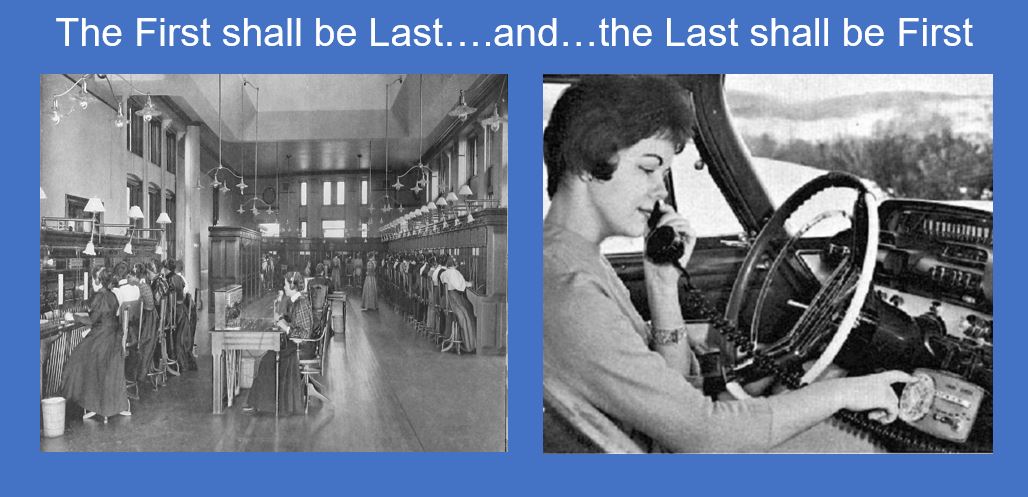
The oldest, most profitable telecommunications services in 1987 failed to digitalise itself end to end, whereas a new, later more problematic mobile service, as it was in 1987, is now on its fifth generation of change. Somebody got there before me in coining the phrase; ‘the first shall be last and the last shall be first’ (Matthew 20:16).