Part ThreeSound Broadcasting
PART 3 – SOUND BROADCASTING
Quote: “If Governments are to intervene, they must intervene comprehensively” (Section B Rule 3The Ten Rules — Rule 3)
Context
A lot of research had been taking place around the world on audio compression (conveying the same perceived audio quality from the studio to the listener using less bits of digital data). In 1986 a research project called Eureka147 began under a European collaborative research framework. The aim was a common standard for Digital Audio Broadcasting (DAB).
The UK’s DAB initiative was begun by an Official in the Department of National Heritage (DNH) concerned that UK sound broadcasting should not be left behind in the digitalisation of the UK’s communication networks. Broadcasting policy has always had a very national focus across Europe and implementing Digital Audio Broadcasting on a coordinated basis across Europe never received same political support as, for example, happened with GSM. This was to have consequences.
Chapter 27
DIGITISING BRITAIN’S SOUND BROADCASTING NETWORKS
Not long after the digital terrestrial TV initiative was under way, I was approached by Jean Goose, a DNH senior official, and asked if I would be happy to work with her to get sound radio into the digital era. I suspect the approach was a bit of ‘real politique’. Her minister would not make a decision, and Michael Heseltine would. I knew her from the days of the Ministry of Posts and Telecommunications. She was somebody who got things done. It was agreed between Peter Brooks and Michael Heseltine that I would chair a review to explore the UK’s options. This was announced in parliament. The review team comprised representatives of the independent broadcasters, industry trade body for suppliers, the BBC and DNH officials.
The BBC lead person was Phil Laven, an engineer by background but now in the BBC Policy Unit. The BBC were keen to get the extra capacity DAB would bring. Coverage of sporting events, cricket in particular, would crowd out all the other things they were trying to do. The independent broadcasters did not want a doubling of their transmission costs. They were quite negative. The trade body for wireless receivers was just a front for Far East consumer electronics companies and their representative did not contribute much. DNH were supportive, but Jean deferred to me when the discussion got technical. As the swing issue was technical/industrial, the review quickly reduced to a conversation between Phil Laven and myself. It all hinged on the choice of radio spectrum for DAB: 1500 MHz or 200 MHz.

The rest of Europe was going for a band at 1500 MHz, but that would make it expensive to cover the whole of the UK with strong signals. The UK uniquely had freed some spectrum around 200 MHz. At this frequency, signals travelled further. More of the UK could be covered with less transmitting stations. That made it much cheaper to cover the UK. But the UK would be on its own. That would make receivers expensive. It might take ages for the volumes to build up, for this to drive down prices and this, in turn, to drive up volumes and audience sizes. It would mean the BBC’s rolling out a network and waiting for years for the DAB audience size to build up.
Phil and I shared the analysis. I turned to Phil and asked if the BBC were prepared to be that patient? The decision was essentially his. He decided it was worth a shot. I decided to back him, and Jean backed me. We reported back to ministers, and Jean put the Whitehall machinery into gear. Jean was particularly imaginative in bringing the independent broadcasters on board. Their licenses were coming up for renewal. Either they could take their chance and bid for them in an open competition, or, if they signed up to putting their programmes over DAB, their licenses would be automatically rolled over. Their enthusiasm for DAB rocketed. The UK was now on its way to digitalising its sound radio.
Retrospective – How well did it turn out?
The DAB network roll-out was foreseen as straightforward but getting a variety of low-cost DAB receivers appearing quickly on the market would be problematic. That is exactly how things played out. The first BBC transmitters went live in 1995, and the BBC launched its DAB service in 1996. The commercial services were added in 1999. The delay for the commercial services was largely due to the regulatory changes that were needed to license commercial DAB broadcasters. Network coverage for the BBC DAB broadcasts reached 65% of the population by 2001.
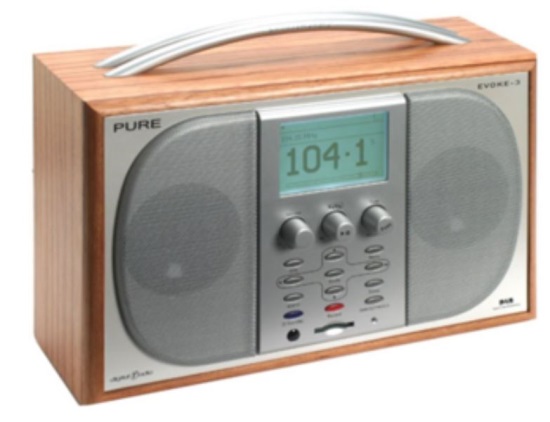
In 2001, the first portable DAB radio was launched by VideoLogic at a price of £499. It was 2002 before a DAB receiver came onto the market breaking through the £100 barrier – seven years after the first BBC DAB transmission. By 2004, ten percent of homes had DAB receivers, and some 85% of the population had been covered by DAB signals. 25% penetration was not achieved until 2007.
The decision in the Digital Britain report in 2009 was to give DAB more time and was taken on the back of DAB penetration having reached 33% of homes. It has allowed penetration to reach 50% of homes by 2015. The work the government did with car manufacturers has paid off, with 87.5% of new cars coming fitted with DAB receivers in 2017 and DAB accounting for 32% of in-car listening.
In 2013, the UK government signalled its intention to transition to DAB+ with the announcement that DAB receivers coming on the market had to be able to receive both DAB and DAB+. By 2016 there were over 30 DAB+ broadcasts in the UK, with Ofcom stating a long-term intention to migrate the UK from DAB to DAB+.
DAB would fall under my category of a half-hearted intervention. DAB is too successful to scrap and not successful enough to displace the analogue FM sound broadcasting. The transition of UK sound radio broadcasting from analogue to digital remains a job half done. In 2016, around half of all those listening to sound broadcasting were still on analogue FM receivers. It has left the industry carrying two sets of transmission networks duplicating the same programmes.