Chapter 26
IGNITING AND RE-IGNITING DIGITAL CABLE TV
There is some irony in the fact that, when I retired from the Civil Service in 1996, I finished-up in the cable TV industry that I had been so dismissive of in terms of their interest in digital television. It was not planned. I joined a small company that was subsequently taken over by one of the smaller cable TV companies called CableTel (that subsequently changed its name to NTL and subsequently adopted the lower case ntl for branding reasons). I became Director of Advanced Technology in ntl’s Networks Division. The reason for arriving in that post rather than government relations was that the Civil Service banned me from having anything to do with any governmental regulatory body for a year after leaving the Civil Service.
In 1996, ntl decided to bid to the ITC to become the UK’s digital terrestrial TV multiplex provider. This decision was nothing to do with me. The initiative came from a senior executive called Jeremy Thorpe. He was a visionary and a risk taker. The top man of ntl was Barclay Knapp. He was also a visionary and a risk taker, they both got on like a house on fire. Jeremy’s vision was interactive services on TV. The ntl bid was ranged against a much more experienced broadcasting consortium led by Carlton, called ON-digital, ntl threw a lot of resources into the bidding process.
Meanwhile, the head of ntl’s TV programmes division was getting worried about BSkyB’s announcement of their new digital broadcasting satellite service. He had no suitable person in his division to consider what the company response should be. I was taken out of my line job in the Networks Division to do a study for him of what ntl’s strategy should be for digital TV.
Shortly after I started the study, I came in one morning and found a large brown envelope on my desk. Inside was a paper that recorded a meeting Rupert Murdoch had held with all his top people at News International in New York to thrash out their digital satellite strategy. It went into the most incredible detail of every single TV channel and service. It was the crown jewels of industrial intelligence. I did not commission it, nor solicit it, nor know anything about it until the morning I found it on my desk. With that insight to hand, I was able to put together a very good case for ntl to move quickly to roll out their own digital TV service. My recommendations included what the services had to be, what network upgrades were needed, on what timescales and at what cost. It maximised the benefits, minimised the investment, reduced the risks and speeded up the time to market.
The next step was to present it to Barclay Knapp. Nothing significant happened in ntl without the support of Barclay Knapp. Would he give it the green light?
Barclay Knapp entered my presentation with the view that the 40 analogue TV channels were sufficient and left convinced the company had to move quickly to deal with the BSkyB threat.
Shortly afterwards, the ITC announced the winner of the digital terrestrial TV multiplex competition. The ntl bid had failed. The result was probably inevitable. The ITC were most unlikely to give away the future of UK terrestrial TV to a relatively inexperienced and unknown US enterprise. But Barclay Knapp was delighted with the media exposure the bid had given ntl. Jeremy’s storyline of interactive services on TV had received massive coverage. The story sold well with investors in the US. He rewarded him by creating a digital media division and putting him in charge. His job was to implement ntl’s digital cable TV strategy.
In the handover meeting, Jeremy thanked me for unblocking the decision to go for digital cable TV. But, to my dismay, he was dismissive of the entire strategy I had put forward. It was far too cautious. The need was not to match BSkyB but to leap over them. The magic weapon was to be… interactive services on TV! He would go out and buy the best and latest technology from around the world from vendors that neither he nor ntl had ever worked with before. He planned to do all of the systems integration in-house with a team that had never worked with each other before. He was going to take on BSkyB’s entertainment proposition with an e-commerce proposition accessed by a TV remote control. I was horrified at the level of risk. I pleaded with him to phase things. The priority was to get something into the market to match BSkyB’s entertainment offer. He gave me a condescending smile and went off to pursue his dream. I returned to my line job in the Networks Division.
Jeremy’s digital TV team were on another site. I was at a distance from what was going on. However, rumours began circulating of considerable delays in the digital TV project. In Woking, where I lived, ntl had secured a very high penetration of the local market by bundling in some free analogue TV channels with our telephone service. It was a good proposition. But it was not strong enough to withstand the onslaught of the new BSkyB digital package. I could see with my own eyes the small black elliptical sky dishes sprouting-up all over Woking. A friend in the media division told me that customers were leaving our cable TV service in droves and special deals had to be offered just to retain them as telephone customers. The UK Board was split between those backing Jeremy Thorpe being given more time and those thoroughly alarmed at the loss of customers.
Things were about to get a whole lot more complicated as ntl secured the finance to take over CWC, the second largest cable TV company in the UK. There was absolutely no overlap anywhere in the market between the two companies. The government had set the rules of separate franchises. Further, the cable TV companies were getting a hammering from BSkyB. There were no competition issues whatsoever. It therefore came as a mighty shock when Stephen Byers, the Secretary of State for Trade and Industry referred the takeover to the Monopolies and Mergers Commission. This paralysed both companies. No conversations were allowed to take place to rationalise their different approaches to digital cable TV. The only beneficiary of Stephen Byers’s perverse decision was BSkyB. After almost a year of delay, the MMC gave the take-over a completely clean bill of health.
What made matters even trickier was that CWC were further ahead than ntl with their digital TV development, but ntl was the company doing the taking over. The relationship that Jeremy Thorpe had with the top ntl man Barclay Knapp gave him and his team a decided advantage in who would come out on top.
One day, my boss Peter Black called me into his office and closed the door. He revealed all. The UK Board was split, and there was a rift between the UK and New York. What was driving New York was how any change of direction could spook the ntl share price, and a rising share price was essential to raising new funds to fund the company. Jeremy Thorpe had been highly successful in selling the vision of interactive services to the US investor community. The UK, on the other hand, was focussed on the loss of our customers in large numbers. Eventually, that would feed through to the bottom line and would come to spook the share price. The company was between the devil and the deep blue sea. I wondered what this had to do with me.
Then he dropped his bombshell. I was to do a secret investigation of both the ntl and CWC Digital TV projects and recommend to the Board the solution the merged company should adopt. I was then briefed by Leigh Wood, the Chief Operations Officer. She was uncharacteristically nervous. It was imperative that news of my investigation should not leak out. I was to speak to nobody in carrying out the review.
I could not imagine how I could do a review of this scope and complexity without talking to anybody. It could not be done. But she was adamant. The company’s ability to attract new money to keep the business running hinged on sustaining the company share price. Brett Richter in New York had done amazing things raising money for ntl, and he was warning Barclay and Leigh that the money would stop flowing in if the market perceived ntl’s strategy was going off-track. Secrecy was essential. I suggested to Leigh a compromise, where we would agree a list of names of people I had permission to approach. We quickly arrived at a very short list. Jeremy Thorpe managed to get agreement that one of his managers, Ken McCann, would be part of my investigation team. I was comfortable with the choice. I brought one of my team along, Jane Herbert.
It was one of the most complicated task I have ever had to do. It involved understanding new leading-edge technology across the entire system, costs, risks, timescales, migration paths, major changes to be made on live systems and, most of all – intense politics. Whichever technology I recommended between the competing solutions would lead to one entire team of engineers having jobs and promotion prospects and the other losing everything.
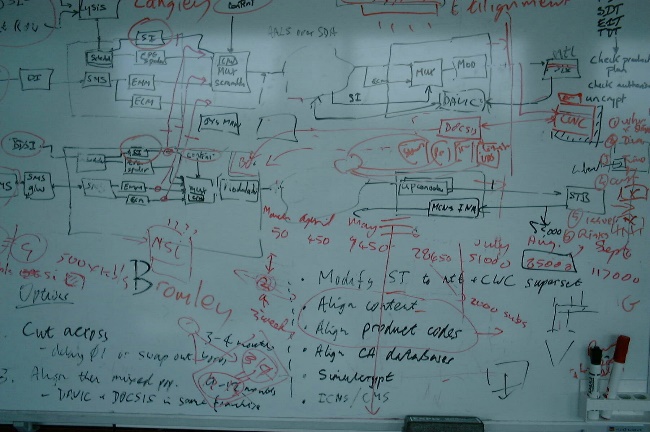
It was a real mess to sort out. My senior Civil Service background was helpful in two respects. I was trained to strip out the non-essentials of an issue. I also knew instinctively how to run a fair process, where all sides felt that they had the chance to make their case.
It was obvious we had to get as far away as possible from any ntl premises when we came to formulate our recommendation. Not a word must leak out. I got my secretary to check us into Cliveden House for a few days. On the last night, I ordered the most expensive bottle of wine I have ever ordered in my life. It was a thank-you to the team. When it arrived, the junior wine waiter invited me to taste it. Frankly, I was disappointed. It was quite sharp. I did not make any comment but screwed-up my face and invited the wine under-waiter to taste it. He felt obliged to say that he would take it back and get another one. I noticed out of the corner of my eye the head wine waiter tasting it and then giving the junior waiter a real rollicking. We fell about laughing. The team had bonded, and that was essential to face the politics to come.
The Board accepted our recommendation. It was the least worst outcome of an otherwise near disaster. ntl got its digital cable TV service back on track. What was rolled out was not too far removed from my original strategy. The ‘interactive services on TV’ proved a disappointment. What looked good on a £1,200 PC in a lab proved to be sluggish on an underpowered £200 digital set-top box with limited memory. Jeremy’s vision was ahead of its time. The box was expensive with all the future proofing, like a bank card reader. It was too complex. The customer would have to be a bit of a nerd to navigate through to find what they wanted just using a remote control. The contention ratio on the return channel was an abysmal 100:1. How could so many intelligent people get it so wrong? What was the value in being handed the crown jewels of industrial intelligence if the Executive then totally ignored it? But saddest of all was the long period the company had left itself being savaged in the market by a very successful BSkyB digital TV proposition. It was not the cable industry’s finest hour.
Jeremy Thorpe, a very talented individual in many respects, left ntl shortly afterwards. I just wish I had had a better relationship with him to have been able to have influenced him to break up his vision into more manageable steps.
Retrospective – How well did it turn out?
It took five to six years to create the digital video broadcasting standards from scratch, develop the systems and set-top boxes and launch the first digital services in 1998 on satellite (October) and terrestrial TV (November). The first digital TV services over cable TV were launched in a few Telewest franchises in 1999 and in ntl franchises in 2000.
The first analogue broadcasting platform to be closed down was the BSkyB’s in September 2001. Some 240,000 analogue viewers had had to be force-migrated over the previous 12 months.
Unlike satellite broadcasting, where the entire service area gets a signal from the first day of launch, it takes many years to roll out a terrestrial TV network over the entire country. By 2007, it was possible to begin to close-down the analogue TV networks. The last of the analogue TV transmitters was switched off in 2012.
In 2013, the ex-TV spectrum not being used for the digital terrestrial TV broadcasting was auctioned for 4G mobile broadband services. It brought much needed mobile coverage improvements in rural areas.
In terms of broadcasting policy, the digital terrestrial TV platform turns out to have been just the right size of pool, open enough to sustain competition, plurality and choice, but not so open that US global media giants would eclipse our medium-sized players and knock out our original TV programme production. The compromise I reached with DNH officials on ‘quality versus quantity’ turns out to have been spot on and more than able to hold its own against multi-channel satellite/cable over a 20-year period. The independent programme-making eco-system has thrived, a lot of TVs now come fitted with digital terrestrial receivers and very high penetrations have been achieved. It has come to dominate the way the second TVs in the home are served.
The switch-over on cable TV networks was more gradual. There were not the same cost pressures from having to pay a third party to run two platforms in parallel. The pressures to close down analogue TV channels came from the need to find more spectrum for the rapidly expanding broadband Internet service using cable modems.
The switch-over has stretched over 20 years from the time I put the first submission up to DTI Ministers in 1993 and started the competitive race between the different means of digital TV broadcasting in the UK market.
In 1993, my concern was Rupert Murdoch’s digital satellite TV platform’s racing ahead in the UK market and coming to dominate British digital TV broadcasting. In 2017, according to BARB, there were roughly nine million satellite-only homes in the UK (37%), four million cable-only homes (17%) and 11m terrestrial-only homes (46%).
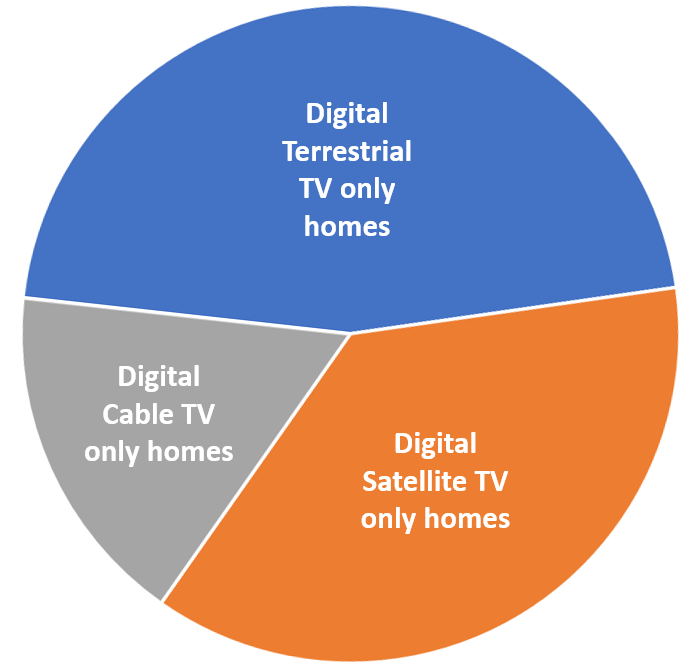
UK homes · 2017
Source: BARB, 2017 · 0–100% scale. Original chart ↗
My policy of platform diversity to contain Rupert Murdoch’s road to dominance was remarkably successful. It is one of the few initiatives to hit its policy objective so precisely a quarter of a century later. Another party with reason to feel well pleased was Luxembourg. Their role in the 1977 satellite broadcasting conference is mentioned in Chapter 32. This little country has a long history of running rings around the big European powers in undermining national control over broadcasting – a story worth a book in its own right.