Chapter 17
THE TURNING POINT – BONN MEETING OF MINISTERS
Back in the UK, a general election had been called. Mr Pattie agreed to take time out from electioneering to attend the Bonn meeting of ministers. The embassy in Bonn contacted me and said that the ambassador had invited Mr Pattie and two officials to be his personal guests at his residence. Clearly, Mr Pattie’s personal secretary would be one guest. I contacted the embassy and put in a special request that the ambassador receive an additional guest. A war had broken out between the two operators on the GSM frequency channel issue. This had almost wrecked
cooperation on the European project. Blessed would be the peacemaker if the relationship between the two sides could be restored to some working basis. The ambassador agreed. Gerry Whent of Vodafone and John Carrington from BT were both delighted with the invitation to join the minister’s party at the ambassador’s residence. Meanwhile, the German PTT was asked to book me into a local hotel – clean, comfortable but distinctly not cool compared with our embassy in Bonn.
The meeting of ministers on 19th May 1987 was more of a ceremony than a meeting. There was a short speech from each party. When it came to Mr Pattie’s turn, he raised the need for an operators’ agreement. He suggested that the ministers instruct their officials to have such an agreement drawn up in the form of a Memorandum of Understanding ready for CEPT Director Generals to sign in September. This was agreed. There followed the signing of a common declaration by the four countries on the introduction of a pan-European public digital cellular radio service. In addition to the minister signing for the UK, John Carrington from BT and Gerry Whent from Vodafone also signed the declaration. The original UK official copy is displayed in the Science Museum.
For the first time, Germany, France, Italy and the UK had committed themselves to a common strategic vision for Europe’s mobile radio infrastructure.
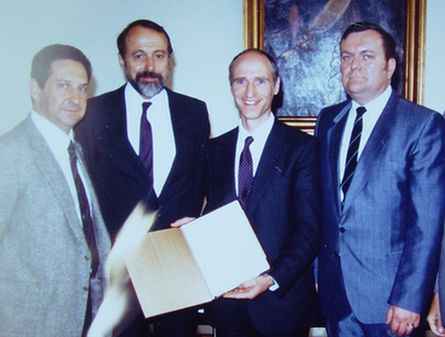
Afterwards came a press conference. One reporter asked Mr Pattie whether an incoming Labour administration would be committed to the agreement. Mr Pattie was too wise a political hand to fall for that one.
The agreement was treated with scepticism in other parts of the world. This view is best summed up by a reported comment made by Bob Foosaner (former FCC Chief of the Private Radio Bureau) in July 1987 that ‘…these agreements are the first of their kind, but will they hold?’
That evening, the German minister hosted a dinner. As the meeting broke up, we made for the lifts in the hotel where the dinner was being held. As it happened, Gerry Whent and I travelled down in the same lift as the German minister. I suspect out of politeness, Gerry Whent congratulated the minister on finding a solution to the GSM standards argument. The minister shot back that for some people a lot of face had had to be saved. As if for emphasis, he repeated ‘…a lot of face!’
I made my way towards a minibus the German PTT had laid on to get me back to my hotel. Already sitting in the minibus was M Grenier, the very senior French PTT official I had had the row with in London. He had clearly forgiven me. He grinned and thrust a bit of paper into my hand. I looked at the scrappy bit of paper. It was some ideas for the proposed European Telecommunications Standards Institute. It looked suspiciously like another large initiative. It was. (Chapter 29 picks up the story of how a few lines written in a Commission Green Paper in 1987 had governments running to set up ETSI).