Chapter 10
THE TECHNOLOGY CHOICES – THE EASY BIT
The French and German governments had tried to position the decisive European decision processes as the best performer in the Paris field trials. They had been quite open in allowing other countries to contribute their technologies to be tested alongside. There seemed an implicit assumption by the SEL-led consortia that, providing their system performed, it was home and dry. My strategy was a wider comparison based on the six more market-oriented criteria.
There were a number of key events scheduled on the international calendar in the second half of 1986 leading to the selection of the preferred technology.
The Madrid GSM meeting in September 1986 would put the seal on the rules of the selection process. Later in October, there was to be a Technical Conference in Stockholm on digital mobile radio. The Nordic countries ran it. It was not an official event, but its timing made it an influential peer group meeting. In November/December 1986, the Franco-German R&D trials would be run off in Paris. In The Hague in late January 1987, an expert group of the GSM would analyse the R&D results and draw up a technical recommendation. All this would lead to a meeting in February 1987 of the GSM itself in Funchal, on the Island of Madeira… to make the most significant decision of the decade in mobile radio. Between The Hague and the Funchal meetings, the UK was hosting the meeting of the quadripartite digital cellular radio cooperation agreement.
The Madrid meeting of the GSM was a good-tempered affair. The Spanish Telefonica telephone company were excellent hosts. The meeting agreed that the objective was to select a technique rather than a particular manufacturer’s solution. I proposed that the GSM should set the height of the hurdle at a readily achievable level. We should select only the broad parameters of technology. That would be difficult enough. There were a lot of different versions of the narrowband TDMA technology around. The press would quickly seize upon any small disagreement over detail as evidence of the inability of Europe to agree – once again. This would cast a shadow over the initiative. The French added the suggestion that the choice should include with or without frequency hopping. With this gloss, there was unanimous support for this approach.
The Madrid GSM also revealed a change in the leadership of the German delegation. The German PTT minister wanted to see a much greater priority given to mobile services. The mobile radio section head post was split, and the incumbent, Klaus Spindler, elected to run the new part dealing with private mobile radio services. A new man was brought in to run the public mobile radio services section. His name was Armin Silberhorn. He turned out to be somebody who not only understood the technical issues well, had a good commercial mind and also possessed very great determination.
We spent an evening touring the sherry bars of Madrid to get to know each other, and I came away with a good impression of a trustworthy partner and a hangover.
The technical conference in Stockholm should have been a relaxing affair, but my nerves were on edge even before I started out. Donald Cameron had sent me an advance copy of a speech that his director, Professor Gosling, intended to give. I wrote back asking him to remove the section about the French minister’s wish for competition being a problem for Europe. I argued that this wasn’t something for a manufacturer to raise at an international forum. I made many other suggestions concerning diplomatic problems the speech was likely to cause. All to no avail.
Then, on the plane and airborne, Ted Beddoes told me that Racal’s Research Director was about to give a speech in London to the Institution of Electrical Engineers. He was proposing to cast doubt on whether digital technology could carry any more traffic than the existing analogue technology, and his conclusion was that no-one should be bothering with the digital technology just yet. My first concern was whether it was true. The second was that it was not exactly opportune to raise it in public now. His engineers had been fully locked into our DTI consultation arrangements. Why hadn’t this concern been raised much earlier? What I would have given for a telephone service on board the aircraft at that moment!
The conference itself lived up to expectations. The tension could be felt. Professor Gosling’s speech irritated all our French colleagues as predicted. Donald Cameron explained to me later that, at that time, Plessey were nowhere in cellular radio. They had to take an aggressive profile just to be noticed. To be fair, Professor Gosling’s speech contained some important messages, although I doubt anyone spotted them. One was the need for Europe to move and hit the 1991 window if it was to stay ahead of the North American digital technology threat. But I wished Donald had toned down the political bits.
Most of my time at the conference was spent chasing one European expert after another, trying to tie down just how much extra traffic the proposed digital technology would carry over the analogue technology. Opinions seemed to vary between slightly better to ten times better.
Eventually, one expert from Ericsson Research showed me some graphs. They showed that for the same capacity, the digital technology would give a higher voice quality. If you then adjusted the analogue technology to bring the voice quality up to the same level – the capacity of the analogue system would go down. This didn’t seem a compelling argument. Customers seemed quite happy with the voice quality they were getting.
More encouraging was the view of another expert that analogue systems would set a physical limit to how close radio cells could be pushed together to increase capacity. The limit would be set by intelligible cross talk between telephone calls, i.e., one user would start to hear, in the background, the conversation on another telephone call. With digital systems, the cross talk would be a hiss, rather than an audible conversation. In this way, cells could be pushed closer together. That sounded a little more convincing but not exactly overwhelming.
This degree of vagueness on something as essential as the system capacity was the trigger, later, for the UK to insist, in Madeira, that the GSM standard must include a provision for a half-rate voice coder. In this way, if nothing else, the capacity of the GSM system could be doubled over the life of the system simply by introducing new handsets with a half-rate coder that captured advances in voice coder technology.
Towards the end of the conference, the session chairman decided spontaneously to give an off-the-cuff tutorial on some of the technical problems with the digital mobile technology. It was well-intentioned. Unfortunately, the list of problems was so long as to lead to a rather flat note for an otherwise successful conference. I’d been feeling somewhat on the defensive on the part of the UK after Professor Gosling’s speech. It was an opportune time to buff up our European credentials. My intervention was along the lines that the technical issues were important, but the greatest problem was to get 15 European countries to agree at GSM in Madeira. I expressed confidence that with the support of the experts in the room, Europe could pass this great test and GSM would become a flagship of European cooperation (a line I’d borrowed from John Fairclough). Flowery speeches are not my normal fare, but it brought a round of applause, and getting the atmosphere right can certainly influence willingness to compromise.
November 1986 merged into December as vehicles trundled around the streets of Paris and millions of data bits flew through the air to be captured and fed into computers for analysis. The media was beginning to take an interest.
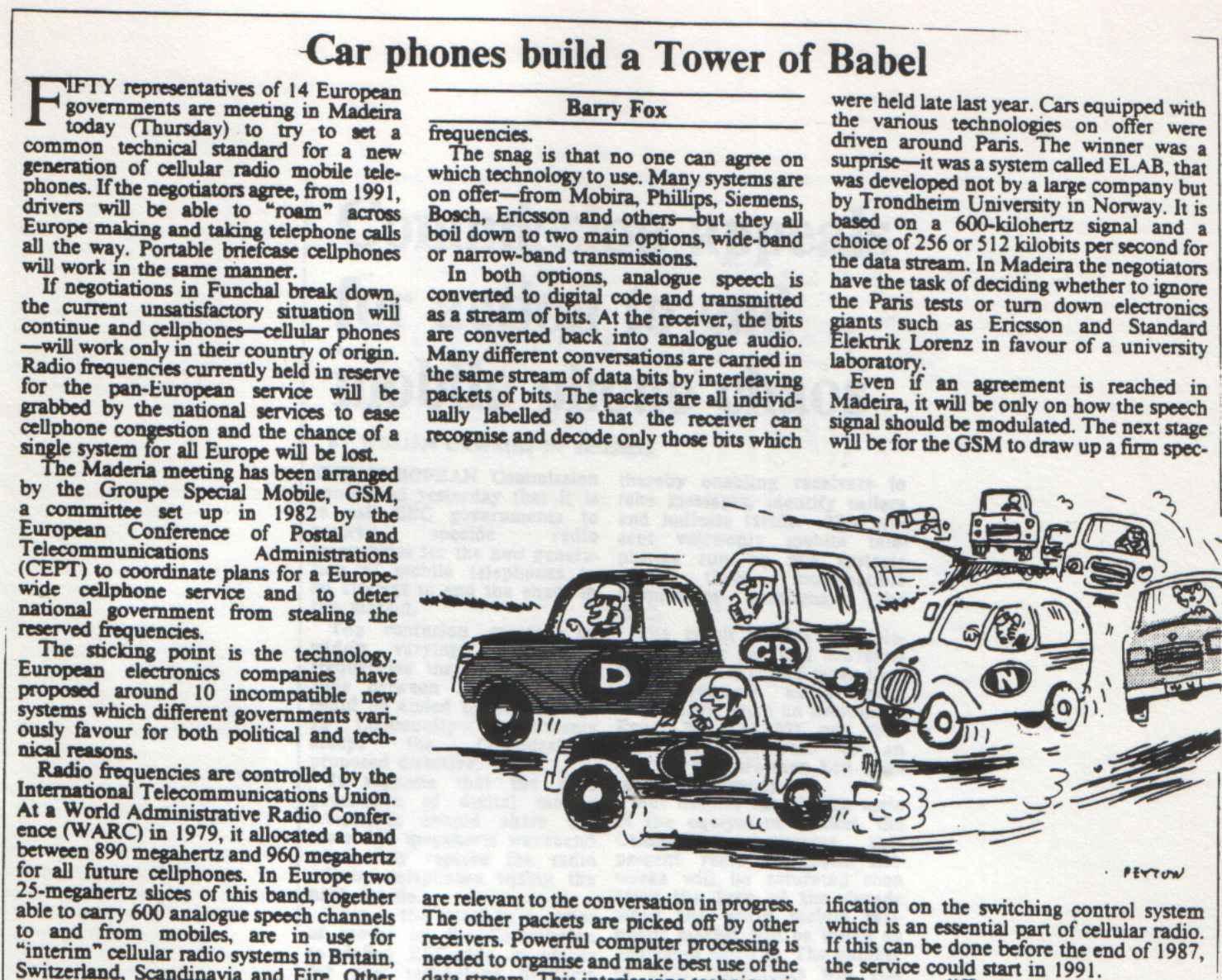
Various systems from the Franco-German R&D programme were tried out. When it came to the turn of the SEL wideband TDMA system, the word came back that it had problems. Its critics nodded knowingly.
A week later, the opposite news came through. It had performed according to the expectations SEL had for it. Credit where credit is due. It was an excellent achievement by their research engineers. They certainly confounded those critics who said that it could never be made to work.
Then came the turn of Ericsson to try out its narrowband TDMA system. It underperformed significantly on expectations. Shock waves rippled out from Paris.
Other test beds were towed around Paris, including a TDMA test bed from Nokia, but none shifted the balance of results.
The tests, to all intents and purposes, were over. A proven performance versus a system which should have done better but, on the day, didn’t. The prospects for the narrowband TDMA started to look grim.
All that was left was for a little-known university-based outfit from Norway to trundle around Paris with their lash-up of a narrowband TDMA system. The large industries hardly gave it a second thought. Then even bigger shock waves of seismic proportions emanated from Paris. The Norwegian lash-up of a narrowband TDMA system from Trondheim University had outperformed the SEL wideband system from a star-studded industrial consortium.
Thanks to two inspired Norwegian researchers, Torleiv Maseng and Odd Trandem, the game was still wide open.