Chapter 14
IT NEVER RAINS BUT IT POURS
In the first two weeks after the February Madeira meeting, a letter went from the DTI minister, Mr Pattie, to the French minister, Gérard Longuet. In the letter, we tried to imagine the internal argument going on in France. Our aim was to give ammunition to those who might be fighting for the narrow-band TDMA cause. The way the UK had turned their back on the French effort to find a common solution to the first-generation analogue cellular systems had not been forgotten in the French PTT. The letter was largely discounted on these grounds.
With Germany, we took a different tack. It was very low key. Our aim was to make the German senior officials aware of our intense interest and add a further dimension to their decision-taking. We couldn’t afford any risk of the letter itself causing offence. That said, the letter did very little good, either.
We briefed the press about the Madeira outcome. I was invited to give a lunchtime speech by one of our leading trade associations, the Electronic Engineering Association. Amongst its members were a number of large multinationals that I hoped could be relied upon to report back to their European headquarters. There is always a tendency to overestimate the internal communications of some large organisations! I gave a very upbeat speech, exuding confidence that the decision for narrowband TDMA was inevitable.
Our embassies in Paris and Bonn were briefed to apply pressure.
We soon ran out of things to do! After all the diplomatic salvos had been fired, there came a lull. It then became a matter of waiting. The game was playing out elsewhere.
There is an expression, ‘It never rains but it pours.’ The whole European GSM project was in a precarious position. France was pulling out all the political stops to hold Germany in tightly to the agreement that would effectively give Alcatel technology supremacy. The market leaders in cellular radio, the Scandinavians, would immediately launch a standards war. Europe’s mobile radio industry was poised, once again, to balkanise. The only thread holding things together was the UK, which, on the one hand, sat inside the quadripartite digital cellular radio agreement (with its links to Germany and France) and on the other, had become the de facto leader of the narrowband TDMA camp. A very weak thread indeed!
Then the UK itself started to fall into disarray.
Vodafone picked its timing impeccably. There was absolutely no information coming out of France or Germany. The tenor of the Vodafone attack was that we were being ‘monkeyed about’ by the French and Germans, with little prospect of getting anywhere. Meanwhile, we could at least make a success of our national analogue mobile radio networks. Could we now have the loan of 3 MHz worth of the GSM frequency channels?
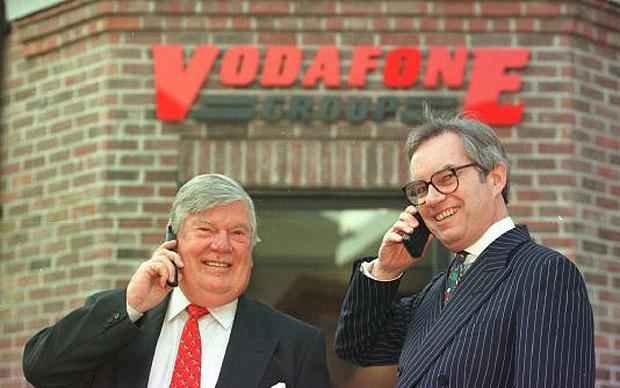
The minister demanded information from me on the European situation. Separately, he asked for a report from the Radio Regulatory Division on the frequency channel situation. The minister’s private secretary told me that, as Mr Pattie had handed him the file, he’d said he was minded to give Vodafone what they wanted. We were to learn later that Alcatel were making the mirror image argument to French and German officials that the UK government would inevitably cave in to Vodafone, the narrowband TDMA camp would then fall into disarray… so why not get on with making a success of new wideband TDMA cellular radio networks in France and then Germany?
This flurry of activity coincided with my colleague John Avery’s applying his mind to the competition implications of the Vodafone request. Everybody, with one exception, was bending over backwards to find a way to give Vodafone what they wanted.
He asked one of his staff, ‘Would we all be doing the same if the request had come from British Telecom?’
‘Certainly not,’ shot back the Grade Seven official.
‘That confirms my suspicion that we are not being even-handed,’ said John Avery.
It also confirmed my long-standing impression of John Avery as a sound regulator.
‘We must get the matter put over to the Director-General of Telecommunications at OFTEL,’ he instructed. ‘We need a ruling on the competition implications.’
The minister agreed.
Later, Professor Carsberg was to remark dryly to John Avery, ‘That’s a right poisoned chalice I’ve been given.’ I just welcomed the extra breathing space.
Meanwhile, Cellnet (and BT) had become thoroughly alarmed at what was going on. They launched a very public campaign against Vodafone being given the channels. They complained that in the previous year, their investment had fallen behind their customer growth. The degradation of service had led them to lose customers to Vodafone. Now the boot was on the other foot, Vodafone were running off to the government for a quick, no-cost fix. It wasn’t fair. Further, if Vodafone were given the channels, that would be the end of the pan-European cellular radio initiative.
So public was the campaign that it was going to be a self-fulfilling prophesy. They were turning my speculation of possible damage into an almost certainty. Bernard Mallinder phoned me from Paris. He’d been put on notice by British Telecom to leave the GSM permanent task team and come home.
Previously, when there had been public slanging matches at the Director level between Cellnet and Vodafone, the cooperation in GSM between engineers lower in the two organisations had been largely unaffected. Perhaps a bit of leg pulling. This was quite different. Bitterness permeated all the way down to the lowest working levels on the collaborative R&D programme and CEPT GSM activities.
Vodafone felt a certain indignation when city analysts started to predict massive shortfalls of their profits if they were denied the channels.
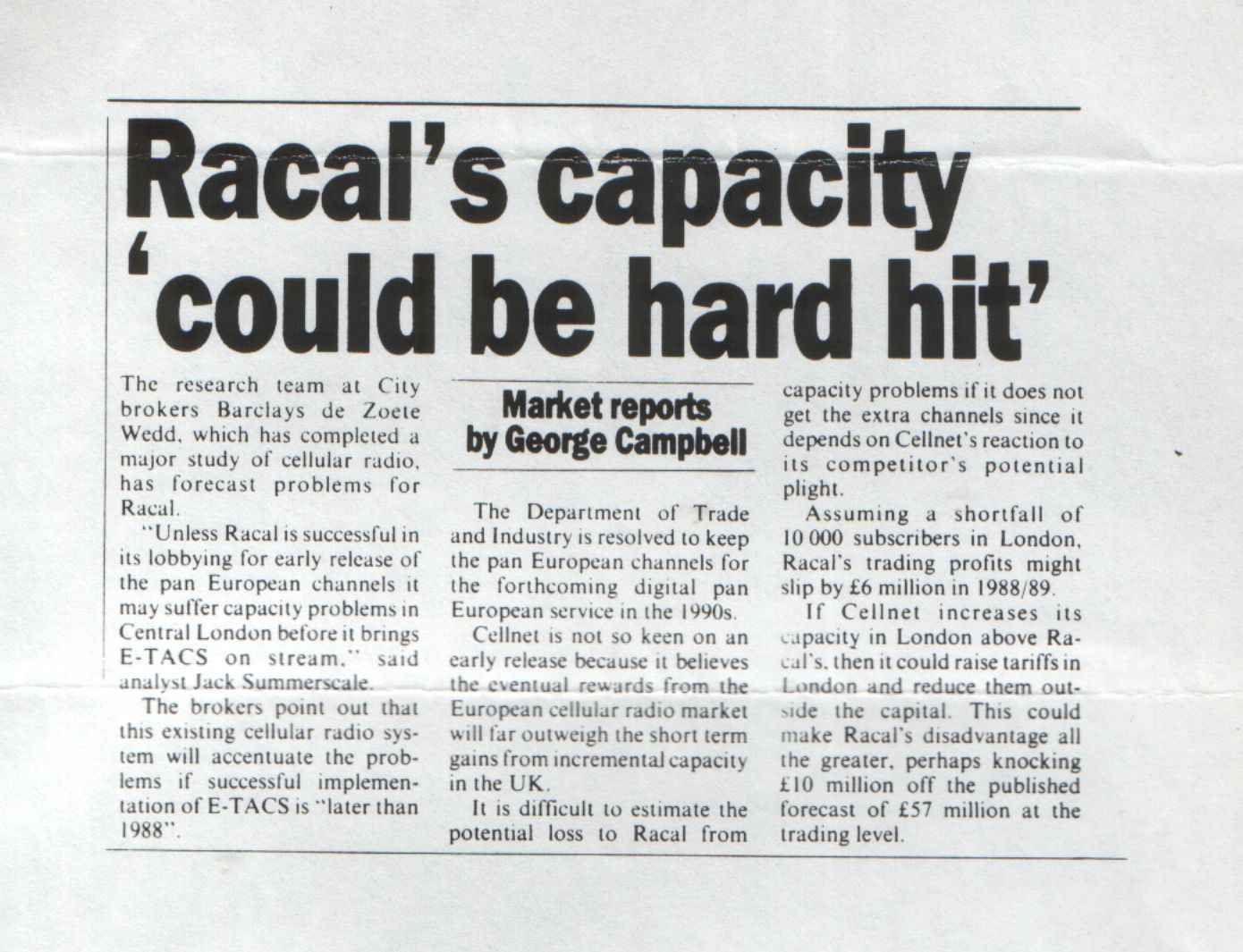
‘Who is feeding this disinformation to the city?’ they asked. Then corporate British Telecom waded in. They would take the Secretary of State to court if he conceded the Vodafone request, they hinted. ‘BT’s gone nuclear,’ remarked John Avery to me.
In parallel with this domestic drama playing out, I was attending a series of meetings in Brussels throughout March 1987. They concerned a draft directive reserving the GSM channels solely for the pan-European digital cellular radio system from 1991 onwards. The date so far in the future offered no obvious help to my immediate domestic predicament. The Commission officials could see the commercial pressures building up, not only in the United Kingdom but elsewhere. Michel Carpentier, the head of DG XIII, wisely decided that the Commission should table the draft directive to hold open the European opportunity.
The initial Commission text explicitly mentioned the precise 10 MHz we were holding back for GSM. The Germans objected because they had located their cordless telephones in 1 MHz of this particular 10 MHz. This was in line with a CEPT recommendation. Just trying to be generally helpful, I suggested to the Council working party that, in order to meet the German concerns, the text could be redrafted to reduce the 10 MHz to 9 MHz. The Germans offered an alternative solution. This was to refer to countries holding back any 10 MHz anywhere of the full European cellular radio allocation of 25 MHz. The Commission officials took both these ideas back to tidy up the text between meetings.
At the next meeting, the new text read, ‘any 9 MHz of the full cellular band of 25 MHz’. In other words, they had combined the two ideas, apparently not realising that they were two different ways of solving the same problem. They could have restored the 9 MHz to the full 10 MHz in the new formulation. I sat there in the meeting in Brussels musing on whether to bring this to their attention. A germ of an idea occurred to me. I kept quiet. Nobody else had spotted it.
Next day I put my idea to my chief Robert Priddle. It was clear that with the current public profile of the issue, if Vodafone weren’t given something, their credibility would take a real knock. That was not in our interest. But that is not to say that they had to be given everything they’d asked for. They had actually asked for 3 MHz. If they were given, say, 1 MHz (the piece that had fallen out of the draft directive), it might just about get them out of their corner. To Europe, we could claim that we hadn’t given away any of the 9 MHz of spectrum ‘identified in the EC Directive’. British Telecom could claim that their lobbying had squeezed Vodafone down from 3 MHz to 1 MHz.
Robert appeared only half convinced but thought the idea worthwhile having up our sleeves.
I phoned the OFTEL official dealing with the case to put the European situation to him. The official told me that the European implications were for the DTI to deal with. They were only going to treat the competition issues. I reminded him of Professor Carsberg’s statement some while earlier that he saw the pan-European system as being very much in the consumer’s interest. I added that surely a company as sophisticated as Vodafone didn’t ask for precisely what they actually needed. Couldn’t he at least put in the option of giving Vodafone less than they had asked for if that were to be necessary to cope with the international implications? He promised to put it to Professor Carsberg.
There was a long-standing meeting with Vodafone and British Telecom to discuss our fall-back position on the GSM technology arguments. In view of the complete standoff between the two companies, I thought it would be prudent to see them each separately. I met John Carrington first at the beginning of April. Having disposed of the European issue, I turned to the Vodafone request for the temporary loan of the GSM channels. I weathered his verbal battering and pressed on. Surely he’d had enough experience of the political levels to know that the political odds were in favour of Vodafone being given something. John Carrington acknowledged that this appeared to be the way the wind was blowing. He said that they felt that they had not got their case across to OFTEL.
This was the cue to float out my 1 MHz idea, emphasising that it was purely a personal idea. His colleague, Peter Carpenter, leapt in immediately and said that they would demand the same.
‘What for?’ I asked. ‘You’ve said publicly that you don’t need them. Why don’t you ask for something you do need? You’ve been hemmed in on a number of fronts by DTI/OFTEL.’
‘Such as?’ John Carrington demanded.
‘That is for you to decide,’ I said. ‘But purely as an example, OFTEL have been denying you an additional paging channel. This has been a thorn in your side.’
‘That thought had crossed my mind,’ said John Carrington.
The matter was left there.
The paging channel example hadn’t been plucked out of thin air. I’d met the Deputy Director General of OFTEL, Bill Wigglesworth, socially many months earlier. We’d got around to talking about paging competition. He’d mentioned that they had denied British Telecom an extra paging channel in order to get the competition established. But they now recognised that they would have to give them the extra channel. Otherwise, British Telecom might find other ways of increasing the capacity by introducing a new standard. This would be an even greater disadvantage to British Telecom’s competitors. Thus, sooner rather than later, OFTEL was going to have to let British Telecom have the extra channel. That little information nugget was ready for market.
The meeting with John Peett from Vodafone was tense. After we’d dealt with the European matter, he took the initiative to present their case for the loan of 3 MHz of the reserve GSM frequency channels. He’d brought Ted Beddoes with him. Graphs were put on the table showing congestion projections under various assumptions. I floated out the one MHz idea with him. John Peett screwed up his face and said that he was appalled by the idea.
‘What if that was the only thing on offer?’ I asked.
‘Such a proposal would be so contemptible as to be not even worth considering,’ he said.
John Peett was one of the best as a negotiator, but that performance took me quite aback.
The crunch was a meeting of officials called by Robert Priddle to consider what should go up to ministers. We had the report from OFTEL. They recommended that Vodafone be given the channels. This surprised John Avery. It would seem that effective rather than fair competition was to be the yardstick. However, I was at least grateful that the hook had been put in concerning the possibility of a reduced amount of frequency channels… if the international situation demanded it.
The head of the Radio Regulatory Division and one of his assistant secretaries were present. His assistant secretary was in favour of giving Vodafone everything they were asking for. If frequencies could be commercially exploited, that was to be preferred to their lying idle was his argument – which, to be fair, accorded with good economic principles. I pitched in with my one MHz compromise. John Avery immediately supported it. The discussion went around in circles, but Robert Priddle got everyone lined-up behind the idea.
Robert put a masterly submission up to ministers, proposing that soundings should be taken on the proposed deal. He got authority from Mr Pattie to proceed.