The Story of GSM/2G
A European standard
GSM can trace its origins as far back as 1975 when Henry Kieffer from the Swiss PTT suggested Europe needed to find new spectrum for mobile at 900 MHz – the vital raw material for radio.
Setting-up of GSM was the next significant milestone. Similar standards activity also started in USA and Japan. In those countries the standards responsibility for the radio and the linked network were split between different standards bodies. A similar split had existed inside CEPT. The critical decision in 1982 was to allow GSM to define everything it needed for itself. This secured a competitive edge for European mobile standards making.
Over the next few years GSM became a funnel for ideas from every R&D Lab in Europe. Great institutions like CNET, CSELT and BTRL, key Industrial Labs (Ericsson, Alcatel etc) and many Universities were all drawn into this exciting new opportunity – to digitalise Europe’s mobile networks.
1987: the Bonn agreement
The meeting of Ministers on the 19th of May 1987 was more of a ceremony than a meeting. There was a short speech from each party. When it came to Mr Pattie's turn he raised the need for an operator’s agreement. He suggested that the Ministers instruct their officials to have such an agreement drawn up in the form of a Memorandum of Understanding ready for CEPT Director-Generals to sign in September. This was agreed. There followed the signing of a common declaration by the four-countries on the introduction of a pan European public digital cellular radio service. In addition to the Minister signing for the UK, John Carrington from BT and Gerry Whent from Vodafone also signed the declaration.
For the first time Germany, France, Italy and the UK had committed themselves to a common strategic vision for Europe's mobile radio infrastructure and a fuse lit on the GSM “cosmic big bang”
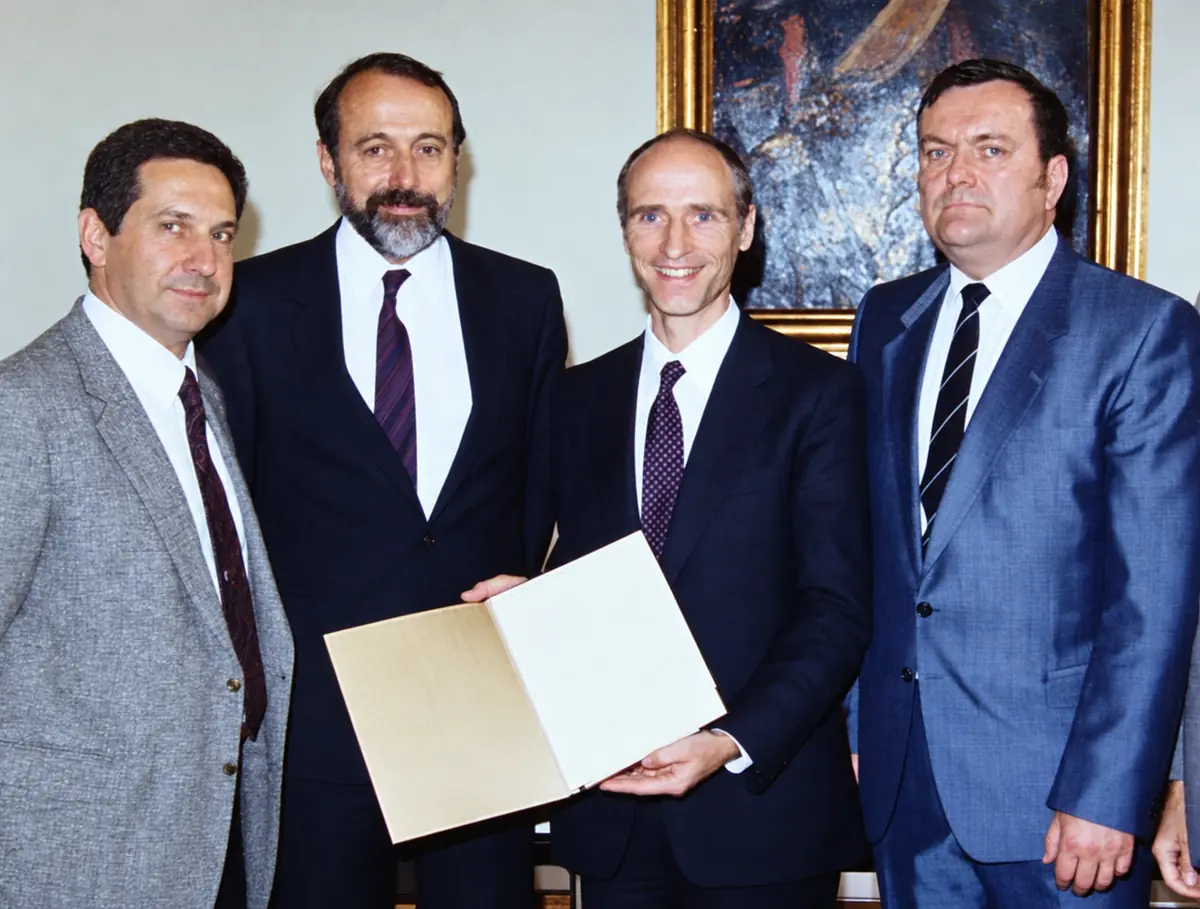
An agreement to build networks
At the end of July 1987 the Italians had arranged a large technical conference on digital cellular radio in Venice. I agreed with Armin Silberhorn, Philippe Dupuis and Renzo Failli to take advantage of the event to draw up the proposed commercial operators’ agreement that I named “a Memorandum of Understanding”. We all agreed that we should extend the co-operation at this critical stage to include Sweden. Through them there was a good chance of bringing in the Scandinavian countries. Renzo Failli had arranged for us to meet in the head office of the local telephone company SIP. They were housed in a magnificent old Venetian building, which they were in the middle of renovating. It was a tasteful blend of modern corporatism and historic preservation. We worked in the Director's office resplendent in dark oak panelling.
My text had been circulated for the commercial operators’ agreement. I'd given a lot of thought to the balance between the competitive freedom of the individual enterprises and what needed to be done in common; the need for consensus where possible and the need for a vote to remove unreasonable obstruction to the common endeavour; the need for co-operation on key matters and the need to preserve competitive freedom of action.
The heart of my MOU was the common resolve to get systems to the same standard into service by a common date of 1991. I reasoned that if everyone was shooting for the same target, they would be under the same stresses and therefore more likely to find common cause in agreeing upon solutions. This was to cause some friction later, with some countries that wanted to join the agreement for political reasons but did not foresee implementing systems on the same time-scale. I stood firm on this point, and it helped in advancing the investment in GSM networks in a number of countries. The impact was to be dramatic. It aggregated together the procurement power of all Europe's mobile radio operators to kick start competitive supply of GSM systems; it combined the markets for the mobile equipment that rippled all the way back to the competitive supply of semiconductor chips and brigaded together all the national service areas into one huge European wide service area for the traveller.
Completing the system
One of the reasons why GSM was so attractive to developing countries was that it was a complete telecommunications network. Standards bodies in other parts of the world only produced a specification for the radio piece of the mobile network. Automatic roaming and handover of calls between base stations required dedicated exchanges for numbering and switching management. GSM took the ideas developed for the NMT network and significantly extended them to support handover between exchanges and information security. A step forward was made in flexibility by using Signalling System No. 7 which was essential to support new data services and SMS.
The other miracle of GSM was that the technical standard was ever completed on time. It was written in “the paper age”…over 5,000 pages of it. Feeding into this was probably 100 times that amount of paper by way of contributions to meetings. The contributors were dispersed right across Europe.
Bernard Mallinder from the UK headed up a full time support team under GSM to accelerate the work and in today’s world might have carried the title of Project Manager.
Networks and a mass market
The very first GSM call was made by the Finnish Prime Minister (Harri Holkeri) in Helsinki to the Mayor of Tampere (Kaarina Suonio) who was in front of the Rosendahl Hotel in Tampere in Finland.
The future success of GSM then passed into the hands of hundreds of engineers from all the major mobile radio operators and the large systems companies. The result was a common cellular radio network right across Europe to serve the needs of the business community – an early triumph for the new European Single Market.
But the future destiny of GSM was not to stay rooted in the business market. Something happened that took it off this path and onto one that was to lead GSM to become the most successful communications network in history – with over 6 billion users. The mobile industry was to move out of its base of professional electronics and into a new world of consumer electronics. The point of origin for this transformation was the seminal publication by the UK DTI called Phones on the Move”.
This was the first public consultation by any government to set out the new visions of Personal Communications as a consumer industry driven by widening the scope for network competition, opening up the 1800 MHz bands, adding 38 GHz microwave links to reduce the cost of back-haul and adding fresh energy to GSM’s scale economies. “Phone on the Move” was conceived and written by Stephen Temple who also proposed and wrote the GSM MoU.
Industry embraced the vision. The mobile revolution was born.
Beyond the first networks
Most technology revolutions have been in the making for quite a number of years before they reach critical mass (the tipping point) and explode upon the world. So it was with GSM and even more so for PCN at 1800 MHz.
It took a long time for my colleagues in Europe to work out what the UK had done with Personal Communications Networks at 1800 MHz in 1989. They were looking for some hidden technological advance. They couldn't believe all the hype when all they could see was simply another GSM network but running at much higher frequency ranges. I attended several conferences to point out that the real revolution was the “regulatory gunpowder” including releasing enough spectrum to open up an unimpeded road to a mass consumer market and the high degree of competition we had introduced that would drive that revolution forward with increasing speed and force.